Mystara of the Five Spheres RPG - Designing Mystara Page
Mystara Pages
Page Content
GM Section
Updates
|
|
Here I show how the setting I call "Mystara of the Five Spheres" has been developed. It shows a few diferent ideas that have been developed over time to make it my own setting and following a few different ideals and concepts as I go. This was designed as a series of articles on my WordPress blog and migrated to my website as part of bringing the content together. It was unsuitable for a blog as I never intended it to be a moment in time, but a work in progress. |
Mystara of the Five Spheres - Re-Designing the Setting
Mystara of the Five Spheres - Overview
The design decisions of my campaign world will be outlined here in a series to help my players understand the setting better. These are reasoning behind the changes to the setting and the house rules used in my ongoing campaign.
- Part 1 – The Five Elements – Talks about why I have five elements and how they relate to each other.
- Part 2 – The Five Spheres of Power – Talks about the gods of the setting and how they relate to the five elements. This lists all the gods, their names and all the things they provide patronage for in the setting. This will be expanded as the gods are detailed.
- Part 3 – The Pantheons – Talks about how the immortals relate to the peoples beliefs.
- Part 4 – The Divine Features – Talks about how gods are important in sustainability, where not having one deprives a character of death saving throws in my campaign.
- Part 5 – The Reference Material – What sourcebooks I am using to build my own version of the setting.
- Part 6 – The Races – Talks about the different races in the setting and how I have grouped them. This is a current project that is on going.
- Part 7 – Secret Crafts Overview – Talks about the special powers granted by the immortals in the setting.
- Part 8 – Weapons Mastery Overview – An outline of how the weapons mastery rules work.
- Part 9 – Setting Overview – A look at the Mystara setting.
- Part 10 – Timeline Overview – A look at when and when adventures would be set in the Wrath of the Immortals timeline.
- Part 11 – Magical Item Overview – Talks about the change I have incorporate into magic items and has example items used in my campaign.
- Part 12 – Classes Overview – What classes are available and where you can find them.
- Part 13 – Downtime – What are my Mystara downtime activities and extra rules.
- Part 14 – Immortality – Discussing rules around character becoming Immortals or Gods of the setting. Designed for Tier 4 play and above.
- Part 15 – Elemental Aspects – Laying out and defining all the elemental aspects that will re reused in the rest of the setting material.
- Part 16 – Immortal Patrons – This will be the core of where classes, crafts and gods will be connected to pantheons and the setting.
- Part 17 – New Directions – Why would you change some of the campaign details mid storyline, and what am I changing after having run this storyline line since 1st July 2015.
- Part 18 – Symbols – What are the purpose of the symbols I am using in the setting and why is it important.
- Building a Kingdom
- Part 1 – Mapping - How to utilise the hex maps and work out a unique way to identify all elements on the maps.
Mystara of the Five Spheres - Part 1 - Five Elements
The world of Mystara for my campaign, has been cleaned up for 5th edition Dungeons and Dragons. For this I have converted it to incorporate a five element concept that all the gods (known as Immortals) of the setting are organised under. I am rebuilding my version of the world to follow these principles of the five as my players progress through the story and explore the world.
The design is split into these main concepts and I am proving an overview of the design for:
- The Five Elements: What are the five elements.
- The Five Spheres of Power: The main grouping on the gods.
- Pantheons of the Gods: The concept of how I am organising the complex structure of the gods in the setting.
- The Divine Features: New character options based on in game religions.
- The Reference Material: What sourcebooks I am using to build the world.
- Mystara Races Overview: The overview and plan for converting races to the setting with an Elemental Theme.
- Secret Crafts Overview: This is the concept of what they are in the setting and where they come from.
- Weapons Mastery Overview: The rules from the original setting converted to 5th Edition.
- Setting Overview: An overview of Mystara and the Known World.
- Timeline Overview: The look at how I am planning on incorporating all the different adventures into the wrath of the immortals timeline.
- Magical Item Overview: How my magical items are different to other settings.
- The Class Overview: What classes are available and where to find them.
- Downtime Overview: Talks about what I am doing with downtime in the campaign.
- Immortality Overview. A walkthrough on becoming an immortal.
- Elemental Aspect – A revist on Racial Elemental types.
The Five Elements - In the setting of Mystara, they have a concept of five that is used in a lot of places, so I have taken that concept of five and used it to expand how most of it is used in game. For example:
- The Five Spheres of Power
- The Five levels of Weapons Mastery
- The Five levels of a Secret Craft
- The five elemental subtypes of races
- The five elements of the world
- Five tiers of play (in this setting, tier five is immortality and achievable through play)
- There are a further five tiers of immortality advancement, once you achieve the first step.
This leads us to what are the actual five elements of the world.
- Air
- Darkness
- Earth
- Fire
- Water
Each of these elements feature in different ways. For example, races gain features based on what element their subrace is connected to, which can provide mechanical and cultural in game benefits.
The Five Spheres of Power - (More detail in Part 2 – The Five Spheres of Power) There are five spheres of power, they are not good, nor evil. How the power is used marks the alignment. If any one sphere becomes dominant over the others then the world falls out of balance and major events come into play to correct that imbalance. This is the premise of the campaign, and is corrected is needed.
Pantheons of the Gods - (More detail in Part 3 – Pantheons of the Gods) see also Pantheons and Gods page references. All the gods will be arranged in pantheons, with a unique name for every pantheon they belong to as the name defines the aspect, belief and options. Not that a single god can’t be followed but the pantheons are being organised under the following considerations:
- Racial – available at Tier 1 and deals with a specific race and their beliefs
- Cultural – available at Tier 1 and deals with a culture that allows more than one race to participate in their beliefs
- Elemental – available at Tier 2 (or Tier 1 if a druid) and deals with an elemental belief structure
- Sphere – available at Tier 3 and deal with a sphere of power belief structure
- Immortal – available at Tier 4 and deals with Immortal politics
- Ancient – lost and forgotten pantheons
Each god will need to fit into its own part of the pantheon as well as the Hierarchies of the spheres. The original design philosophy of the spheres was that there could only be a set amount of gods at any level, and to advance, some would need to be reduced or removed. I have 166 gods listed and undertaking a clean up and rationalisation of them for my campaign world that will make them unique to my setting. A great source of material has been Vaults of Pandius.
The Divine Features - (More details in Part 4 – The Divine Features) This is a new concept that I have added around the Gods providing second chances to its followers. Those who follow gods don’t die when they are reduced to zero hit points, they get the standard saving throws. They also gain other benefits when dealing with people of their culture.
As I progress with more information relating to each of the pantheons, they will gain more information specific to that pantheon as revealed in the ongoing story narrative.
The Reference Material - (More details in Part 5 – The Reference Material) This is a list with comments on the sourcebooks, of where I have sourced all the material I am using to rebuild my version of the Mystara setting. It also contains where and when I expect to be using that material.
Mystara Races Overview - (More details in Part 6 – Mystara Races Overview) All the races are planned to be updated with an Elemental Theme.
With each of these spheres of power, the design concept is to move the racial types into having five sub-types, where one is aligned with each of the spheres. This will re-work a few things, but I believe it will help with a design philosophy to keep things consistent over my changes. Each of the existing races and subraces will be reconfigured to represent this design.
Half-race species are not available to players as I have moved them into the myth they are referred to. All half-races are a magic by product. They have a tendency to go insane, betray and kill those who care about them the most. All races fear and hate half-breeds because of this.
For example: as an early concept for names, Mountain Gnomes (Matter) known to live underground and are the crafters, Forest Gnomes (Energy) known to live on the ground and are the arcanists, Sky Gnomes (Thought) known to live in the sky and are the inventors, Ocean Gnomes (Time) who most believe do not exist and Void Gnomes (Entropy) who no one wishes to ever meet.
Secret Crafts Overview - (More details in Part 7 – Secret Crafts Overview) There are a number of secret crafts of Glantri in the source material, but I have expanded this to link into the five elements so there are crafts that suit all the spheres, and moved the crafts into a grant from the gods. So these become the special powers of followers of the gods.
To learn a secret craft, you need to gain prestige in the craft, find a teacher, get sponsored and live up to the ideas of the craft to advance and become a true master of the craft. All the paths of immortality have been re-worked to be linked to the secret crafts.
Using a secret craft is dangerous as you are channelling the power of the god provided the craft through your mortal body without the protection of spells, talismans or rituals.
All spells that do not come from the players handbook are subject to the secret crafts and will not be generally available otherwise.
Weapons Mastery Overview - (More details in Part 8 – Weapons Mastery Overview) These rules exist in the Rules Cyclopedia for the original version of the game released in the 80s.
An aspect of the setting is Weapons Mastery which is the ability to cause more damage with weapons as you become better skilled at wielding them. So a 1st level fighter cannot compete to the damage a 20th level fighter with the same strength could do. There are other balances in the game, but this is one of the flavour options I have brought into my 5E campaign. It is a human cultural advancement, so not all races in the world have adopted it, and some will shun it for that story reason.
What this introduces is a five tier system of competency showing how characters become more powerful with training.
- Non-Proficient
- Proficient
- Skilled
- Expert
- Master
- Grand Master
Setting Overview (More details in Part 9 – Setting Overview) The setting and information about how it is laid out for players to get an understanding of the region of play. This includes (and will expand) all the Gazetteer regions of the Known World and places they have travelled to in the storyline. This will expand as I migrate material from my Game Management Site.
Timeline Overview (More details in Part 10 – Timeline Overview) This goes onto a breakdown of when and where the different adventures are location. This is linked to the published adventures as this more concerned with the when of the storyline, with some reference as to where it happens.
Magical Item Overview (More details in Part 11 – Magical Item Overview) With the concept of five things of important with the setting, all magical items can have the following: Standard abilities, Attuned abilities, Awakened abilities, Exalted abilities and Relic abilities.
I have looked at the magic of my setting and reworked it such that all ' non-expendable magical items have the ability to used freely, attuned, enhanced and finally to become exalted. Each level increases the power of the item. The first two are generally generic powers, with the last two relating to the specific item in question and how it was used. Every item in the game will have a unique name, history and eventually powers as they grow with the storyline.
Also there are now relics, where an item related to your race will give you powers it does not give one not of your race. All magical items will have a Relic aspect for a race that get a little more out of the item than everyone else.
Artefacts are terrifying to the population, they are a link to the gods, but all carry the curse of their god in different ways. Just holding the item grants you the curse, and you can never hold more than one that does not have a special type of synergy. An artefact chooses you, not the other way around… To further their uniqueness, I am incorporating the rules for artefacts from the setting providing unique aspects not in the current items.
The Classes Overview (More details in Part 12 – The Classes Overview) My class options are also being cleaned up to represent where someone would go to learn mastery of classes. Each winter, characters are expected to find a master to teach them enough to gain a level. There are no level gains mid story, they are all happening over the winter break. Some have been done with downtime rolls, but in future I am planning on moving that to more story than mechanic. This will be discussed with my players.
I have made classes a cultural thing in the setting. So if you want to learn a specific class archetype, you need to travel to a nation that is teaching it, and find a teacher willing to show you how it is done.
The Downtime Activities (More details in Part 13 – The Downtime Activities) While technically this part was written before the rest, it is an important part of the world design as it is how much of the above material is related to players in session and with each level they take. Downtime is all about improving a character, either by abilities, materials or knowledge.
Immortality (More details in Part 14 – Immortality Overview) This is where the updated rules will be discussed and worked out allowing characters to become truely immortal in the setting and stand among the gods.
Elemental Aspects (more details in Part 15 – Elemental Aspects) This is a revisit on the concepts of elemental races in the setting and resulted in the re-writing of those races to fit the setting better.
Mystara of the Five Spheres - Part 2 - Five Spheres
The Immortals of Mystara are the demi-gods, god and elder gods of the setting, unlike other versions of Dungeons and Dragons, they were all mortal and gained Immortality and are worshipped as gods. They derive power from worship and provide power to their followers. This article is my take on how they affect the world of Mystara and builds on my other design articles.
This section covers the following topics:
- The Power of Five: What is the Five Spheres of Power.
- What are the Spheres: A description of the Spheres of Power.
- How does this effect my character: talking about how the spheres affect a character.
- Pantheon vs Specific Immortal: A player character can choose to follow a specific immortal, but most characters follow a pantheon.
- Personalities of the Gods: How the gods work in the setting.
The Power of Five - There are Five Spheres of Power, and there there are five levels of advancement after becoming a god, and many more instances of the use of five in the setting itself. So the number five has a lot of significance associated with it in the storyline and the setting. For this reason five will be used as the special number (or magic number, lucky number) for the determination of planning throughout the design process.
This should be more prevalent in the published material to help tie in some of the concepts as different from the main product line and becomes a core assumption to the changes I am making to my own version of the setting.
What are the Spheres - There are five spheres of power, they are not good, nor evil. How the power is used marks the alignment. If any one sphere becomes dominant over the others then the world falls out of balance and major events come into play to correct that imbalance. This is the premise of the campaign, and is corrected is needed.
How does this affect my character? -
Those who do not believe in following the immortals are not protected by them
against those that want to control the world.
For example: a pantheon grants a protected by the pantheon class
feature.
- Clerics and Paladins – I have grouped my gods into pantheons which represent nature, races, know world, rest of the world and lastly ancient cultures. A cleric and paladin belong to one of these pantheons, and can select either the whole pantheon to follow, gaining certain bonuses related to that pantheon or a specific god and gaining bonuses based on the sphere the god belongs to.
- Druids and Rangers – My druids and rangers can gain the same options as the cleric and paladins, though expect more of a nature pantheon following.
- Bards and Warlocks – I have a new section called patrons. The immortals mostly support bard and warlocks through the the ideal which i have tied to the history skill to invoke their power. They have a specific link to that immortal and don’t follow a pantheon, unless their patron is part of that pantheon.
- Sorcerers and Wizards – To put it simply, it does not affect these classes at heart. If there is something in the class that takes on a Divine, Planar or other worldly power source then that is when they start touching on the Immortals. The way it affects them is they choose a pantheon they belong to and immortals that they are happy to honour as part of the storyline.
Other Characters All characters have a belief system and follow a pantheon or specific immortal. Characters who choose to not follow any immortals (which is a play option) are tormented each night by nightmares, and cannot be brought back from the dead, and have disadvantage against all rolls made against fiends and celestial’s.
Pantheon vs Specific Immortal - If you follow a pantheon you are required to serve all the Immortals of that pantheon equally. They can all task you to do something related to the pantheon you have chosen to honour.
If you follow a specific Immortal inside a pantheon, you have a choice when supporting the rest of the pantheon as long as their request does not go against the ideals of your chosen immortal.
If you follow a specific Immortal outside of a pantheon, you only hear requests from that immortal.
Each Immortal will have a portfolio that they support or oppose, even within the same pantheon. The name of the Immortal is specific to a pantheon, and defines the pantheon limitations that it operates under.
They also posses at least one Artefact that they are known by, with more to come as the campaign progresses and the Immortals are cleaned up further.
Personalities of the Gods - The more powerful an Immortal is, the less they understand mortality, and the less they can directly affect it.
They strive against each other, and the other spheres to advance their own power. They can consider the movement of a pebble in the same level of importance as the survival of a nation or a race. One striving to make a change, and another striving to stop the change.
The reward for success is usually advancement, or holding onto their position. This has been detailed in the Immortal Olympics as one form of their challenges for advancement.
Exactly how they work and what their politics entail is still unknown to the characters in the storyline until they reach Tier 4 through play.
Mystara of the Five Spheres - Part 3 - Pantheons
This is a follow on to the articles about the Immortals and the Five Elements. It lists all the different Pantheons that I am using with a brief description on what that pantheon is for.
- Following an religion in Mystara
- Environmental Pantheons
- Racial Pantheons
- Cultural Pantheons
- Other Pantheons
- Pantheon Descriptions
Following a religion in Mystara - In the terms of my D&D 5E Mystara setting when I refer to a character following a god I mean one of the Immortals of the setting.
- Atheist: A character who does not follow a god or a pantheon dies when reduced to 0 hp as the grace of the immortals allows them death saves. They re tormented by fiends in their sleep and are treated as having 1 level of exhaustion that cannot be removed.
- General Pantheon: A character who follows a pantheon is open to all in that pantheon, and can be tasked or contacted by any gods within.
- General Pantheon but a Specific God: You follow the pantheon, as long as it does not clash with your chosen god.
- Specific God: A character who follows a specific god needs to follow the ideals of that god or find themselves on a quest to appease them.
Environmental Pantheons - These pantheons represent various environments around the setting and are good places for druids and rangers to find their gods (Immortal) or simply follow the concept of the Pantheon.
- Forest – for all creatures of the woodlands and animalistic races. All patrons of the forest, nature and creatures of the forest are found here.
- Ocean – for all creatures of the ocean, both on its surface, and below the waves. Each of the patrons of the sea should be here.
- Radiance – Followed mainly in the Glantri region. Not really considered a religion by its followers. This is also the base fire religion.
- Shadowlands – for all creatures who live deep under the ground. All the underground races were lumped together as there is some overlap in the storylines, so it sort of fits. (See GAZ 13 – Shadow Elves)
- Sky – for all creatures who live in the sky and mountain tops. This was a good place for all patrons of flying creatures and contraptions.
Racial Pantheons - These are pantheons that are more to do with a character’s race than where they are or what sort of environment they prefer. They usually feature racial heroes.
- Dragonkin – Followed by the Dragonborn, Lizardfolk, Kobolds and the Dragons. There are more dragon gods than I expected, though there are references to a previous pantheon of dragon gods that are not listed. (Below)
- Dwarven & Gnome – Followed by dwarves and gnomes. All of the Dwarf and Gnome patrons ended up here as there was not enough to stand on their own in the first cut of the gods.
- Elven – Followed by elves. All elven immortals and their patrons ended up in here.
- Halfling – Followed by Halflings. Mainly halfling patrons and halfling that became immortals.
- Human Pantheons:
- Atruaghin – Followed by the clans only in the region.
- Ethengarian – Followed by the people of Ethengar, where they might be found.
- Traladaran – The religion of the Karameikos subjugated people and can be found where the Traladaran people migrate to.
Cultural Pantheons - These pantheons have gone past those of race and embrace a people based on their ideals. These are founded in the nation or is the cultural source of the human religion. They usually feature heroes of the nation.
- Alphatian Empire – Followed by Alphatian Empire and Genasi everywhere. All the gods are titled. As a major player in the world they have one of the biggest pantheons and it helps show why they struggle to get traction when you have a lot of voices giving directions.
- Land Guilds – Followed by caravan traders, the republic and their diplomats.
- Makai – Followed by the descendants of the Makai ans adopted by those interested in Islander culture.
- Norse – The Norse religion, followed in the region and by Heldannic people in the Northern Reaches.
- Ocean Guilds – Followed by sea traders, the guilds and the region.
- Outcast – Followed by monstrous races such as Orcs, Trolls and Giants. A good catch all group for these races and those who support a more conquest themed religion.
- Thyatian Empire – The religion of Thyatis and Karameikos, based around roman ideals and using descriptors for the gods. Followed by Thyatian people everywhere.
- Ylari – Followers are where you find the Ylari people, Alasiyan and Makistani.
Other Pantheons - Other pantheons exist in my setting, but they are means to be discovered by the characters. They feature nations from around the world, as well as some more ancient ones that are no longer followed.
Pantheon Descriptions - Each of the pantheons has a list of immortals based on the Sphere they belong to. Listed as Sphere/Element (Immortals) with each sphere being on their own line.
Then I provide the list of domains available. They are sorted by Common (available without discussion), Restricted (requires approval and justification), and NPC Only (meant to showcase all options).
I provide details about the Immortals and Domains in my table documentation, which is going through updates.
Mystara of the Five Spheres - Part 4 - Divine Features
As part of my Five Elements discussion, I am now going into what that provides to characters who follow a Specific God or a Pantheon.
When following a specific god, all characters gain the following bonus based on their god’s sphere of influence. This is chosen between Energy, Entropy, Matter, Thought, and Time. Most characters will not follow a specific god, which is why the base anathema relating to spheres is more restrictive than for a pantheon.
Mystara of the Five Spheres - Part 5 - Reference Material
For the conversion of Mystara to 5th Edition Dungeons and Dragons I have pulled together many difference sources. Here is a list of material I am incorporating into my world building and why.
What Material to Use - There are a broad range of material out there now for D&D 5th Edition, but the main issue is what material should I be drawing upon to build my world and make it unique.
The main criteria for using a sourcebook is that I have it available to me either digitally or physically with a preference for both.
- Physical Book – Allow me to have a texture and a smell associated with reading the book that improves memory retention of what I have read.
- Electronic Copy – Allows for easier cross referencing and incorporation of material in my setting.
BECMI - What does it stand for: Beginner, Expert, Companion, MMaster and IImmortal rules for Dungeons and Dragons. Another instance of the use of the number 5 in the setting.
These are the core of the setting, and beloved by a lot of gamers. This features are series of books called Gazetteers, adventure modules and supplements to support the world. I will be incorporating all this material into my world as the foundations. I might not come out the same as everyone remembers, but that is the fun of having a home game.
AD&D 2nd Edition - Dungeons and Dragons was split into two different lines, D&D and AD&D. The “A” represented “Advanced”. The two rules were similar yet very different in play. Basic had races as classes, while Advanced separated characters into racial and class options.
There was a noticeable quality improvement in some of the material as it moved from class is race to races can have classes too. (one of the core differences used to tell D&D and AD&D apart) In my setting these are set after the Wrath of the Immortals storyline so feature in the games future and won’t be used to help build the campaign material. I may pull in elements of Red Steel and the Savage Coast, depending on story needs.
Wizards of the Coast - The new 5th ed rules and adventures will become the rules set and core storylines of the campaign. I am taking apart all the adventures and instead of having them run one game year apart as hinted at in some of the material, to have them all happening at the same time.
This also means that I will be finding regions in Mystara to match up with regions of the forgotten realms (or other places) so the adventures can be based in similar themed areas.
This will make the main sub plots to be weaving through the storyline, each with their own Immortals involved in the planning, progress and conclusion. This is the timeline of the most immortal plots coming to conclusion in the history of the setting, so much upheaval is expected to happen in the pantheons, immortal hierarchies and of course with the world at large.
 | ||
Rules Cyclopedia - The most used book in this series is the Rules Cyclopedia. Hollow World - The Hollow World Material will feature in this material as well. | ||
The core of the storyline will be the “Wrath of the Immortals” three part adventure, which will be re-written and stretched out over 20 character levels with each level representing one in-game year. The events that occur in the four years of the core story now cover most of that twenty year timeline. A majority of the material used for the game comes from this set of rules and products: Gazetteers, Adventures and unique rules. The flavour is also set here as it is where the theme of the five spheres, weapons mastery and secret crafts originated from. Wrath Of The Immortals - Set in the Known World region of Brun, it expands out to Alphatia and into the Hollow World. I have changed the basic timeline of the events to have it broken into three sections, AC 1005 to AC 1009 is the build up, AC 1010 to AC 1014 is the Great War, and AC 1015 to AC 1019 is an Escalated War. I have an Introduction section set from AC 1000 to AC 1004 bringing characters to level 5 before interacting with the main campaign storyline. | ||
| WIZARDS OF THE COAST - ADVENTURES | ||
|
Acquisitions Incorporated - Mystara location – Set in the centre of Darokin or Minrothad, mainly concerned with the Guild building side of things. Baulders Gate – Descent Into Avernus - Mystara location – Set in the centre of Thyatis, Thyatis City itself as the location for Baulder’s Gate in my Mystara. |
||
|
Candlekeep Mysteries - Mystara location – Set in the Mountains of Thyatis and the Hollow World, this is the source of Candlekeep liked to the Mystarian repository of knowledge the Lighthouse. Curse Of Strahd (Re-Vamped) - Mystara location – Set in the Glantri Principality of Boldavia, the events of this module are linked to the Great School of Magic in Glantri City as well as to the history of the Grand Duchy of Karameikos as the root of the culture that settled in this valley. |
||
|
Ghosts Of Saltmarsh - Mystara location – The starting location is set around the Ierendi and Minrothad islands. Icewind Dale – Rime Of The Frostmaiden - Mystara location – The starting location is set around the Norwold region’s upper north. |
||
|
Journel Though The Radiant Citadel - Mystara location – The starting location is set on the Astral Plane with the various adventures available to pop into any region as needed for the storyline. Out Of The Abyss - Mystara location – Set in the Shadowlands between the Outer World and the Hollow World within. Part of the storyline takes them to the Dwarves of Rockhome, the Shadow Elves and the Scattenalfen. |
||
|
Princes Of The Apocalypse - Mystara location – Set in the Northern Reaches nation of Vestland on the border of Ethengar. In these rolling hills is the valley of Red Larch, and the setting for elemental confrontation. I have incorporated each of the organisations into their own Mystarian counterparts. Storm King’s Thunder - Mystara location – The starting location is set around the Northern Reaches nation of Soderfjord Jarldoms, and have links into Karameikos, Minrothad, Norwold, Rockhome, Thyatis and Ylaruam. |
||
|
Tales Of The Yawning Portal - Mystara location – The stories are spread through various locations including Atruaghin (Hidden Shrine of Tamoachan), Darokin (Yawning Portal), Glantri (Dead in They), Karameikos (White Plume Mountain), Rockhome (Sunless Citadel, Forge of Fury, Against the Giants), Thunder Rift (Tomb of Horrors). Tyranny Of Dragons - Mystara location – The starting location is set around the Melpheggi swamps of Darokin and the border with the Tiger Clan of the Atruaghin. It then moves into the northern area of Norwold to the north of the Known World region. I have used Darokin City as the scene for Waterdeep and incorporated each of the organisations into their own Mystarian counterparts. |
||
|
Tomb Of Annihilation - Mystara location – The starting location is set around the Isle of Dawn that separates the Empires of Thyatis and Alphatia. This location in the centre of the island is a good reason for it to be. The Wild Beyond The Witchlight - Mystara location – The starting location is set in the Planar Travel section, though it can literally pop up anywhere in the storyline. |
||
|
Waterdeep – Dragon Heist - Mystara location – The starting location is set around Darokin city in the nation of Darokin. Waterdeep – Dungeons Of The Mad Mage - Mystara location – The starting location is set under Darokin city in the nation of Darokin. |
||
| WIZARDS OF THE COAST - SETTINGS | ||
|
Eberron – Rising From The Last War - Mystara location – The location is set in the nations of the Gnomes, Dwarves and Hidden Kingdoms of the Dragons. Sword Coast Adventurer’s Guide - Mystara location – The provides information on guilds, factions and various racial options I have incorporated into the Known World region of Mystara. |
||
|
Van Richten’s Guide To Ravenloft - Mystara location – The provides information on I am using in conjuction with Curse of Strahd for Glantri. I also intend to use some of this with the various regions of the Hollow World making them all a version of the Domain of Dread in relation to their quirks and limitations. TBA - |
||
| WIZARDS OF THE COAST - SOURCEBOOKS | ||
|
Fizbin’s Treasury Of Dragons - Mystara location – The location is set in the nation of the Hidden Kingdoms of the Dragons. The dragon variants are not well known outside of the region with mainly the five colours and gold being the only metallic known to the population besides their being rumours of gemstone dragons. TBA - . |
||
| WIZARDS OF THE COAST - MAGIC THE GATHERING | ||
|
Strixhaven – A Curriculum Of Chaos - Mystara location – The starting location is set as rival schools of Alphatia and Glantri as the Great School of Magic every caster wishes to train at. Guidemaster’s Guide To Ravnica - Mystara location – The location is set in the Alphatian Empire. Has a lot of Guild material I am using for dual element organisations. |
||
|
Plane Shift – Zendikar - Mystara content – Races. TBA - . |
||
| Organisation Conversions | |
|---|---|
 |
The Harpers - In my version of Mystara I have the Rheddrian’s Investigation Bureau doing the same job as what The Harpers would normally be doing. So I have his agents calling themselves RIB Agents as an optional replacement for references to The Harpers a way of linking to this setting without having to rewrite the existing adventures I have been bringing in. |
|
The Cult Of the Dragon - They are spread wherever there are colonies of dragons. In my version of Mystara I have the Hidden Kingdom of Dragons doing the same job as what The Cult of the Dragon would normally be doing. So I have his agents calling themselves Dragon Agents as an optional replacement for references to The Cult of the Dragon a way of linking to this setting without having to rewrite the existing adventures I have been bringing in. | |
 |
The emerald Enclave - In my version of Mystara I have the Council of Growth doing the same job as what The Emerald Enclave would normally be doing. So I have his agents calling themselves Growth Agents as an optional replacement for references to The Emerald Enclave a way of linking to this setting without having to rewrite the existing adventures I have been bringing in. |
 |
The Lords Alliance - The Lords Alliance is a combination of the Merchant Princes of Darokin and the Merchant Guild Leaders of Minrothad under the understanding that it is best to keep trade open for the interest of both nations. They also serves as the Diplomats of the region, knowing how to seek an arrangement between two parties that is fair, respects their cultural identity and provides an advantage to the Lords Alliance in the long term. |
 |
The Order of the Gauntlet - Each of the Paladin Organisations of the setting will be affiliated with the Order of the Gauntlet keeping the base name, but having branches in many of the Pantheons of the setting. They travel as Order of the Gauntlet when not wanting to advertise their political affiliations. |
|
The Red Wizards of Thay - I am using the Red Wizards of Thay in Mystara as agents of the Great School of Magic. They are centralised in the Principalities of Glantri and wander from that region on tasks for the school, the the princes. | |
 |
The Zhentarim - Each of the Paladin Organisations of the setting will be affiliated with the Order of the Gauntlet keeping the base name, but having branches in many of the Pantheons of the setting. They travel as Order of the Gauntlet when not wanting to advertise their political affiliations. |
Other Publishers
AAW Games - I stumbled across these guys on Kickstarter with their Mini-Dungeon Tome and picked it up with their Underworld Races & Classes. With these two books I have an encounter without the need to plan, and I have a wonderful expansion to the underworld. I am waiting on Rise of the Drow book as I have loved their material to date, and like the concept.
While Drow are not officially in the Mystara setting, there are a group of Underground elves that deal with the Entropic (or Fiendish) Immortals and dabble in sentient sacrifice (not really human sacrifice if they also kill other races) and could use this as a base for their culture.
Frog God Games - I have played with their Lost Lands setting since they first started releasing material under the Necromancer Games badge and continued to pick up their Pathfinder material and now most of their 5th Edition books.
I intend to make parts of the Lost Lands migrate to Mystara and fill out one of the other continents with their material. This gives me something I can just drop into place for when my players venture that way in the storyline.
Goodman Games - These guys have released two fantastic Mystara supplements that I am taking as is and dropping into my world where they were meant to sit. I know there is more to come, so will add them as they reach my shelves.
Green Ronin - These guys came to PAX AU (and they didn’t learn from the first one and came back) and are the only company I have met in person. I had a great time talking games with Chris and Nichole and they remembered talking with me the year before. This might have contributed to me buying the Critical Role book and the Book of the Righteous. This was a good thing as these books are amazing and have expanded my game world.
They also gave me the idea and push to rework the gods and make sense of them for my setting. (see the Immortals blog entry)Kobold Press The Midgard setting really gives me a lot of inspiration for building up the Norse mythology that already exists in the Northern Reaches section of the Known World region.
And their material on Deep Magic has been used to expand my worlds spellcasters, and they have a new kickstarter hopefully delivering cleaned up material shortly.
The third thing that have done to make my games better is the Tome of Beasts and Creature Codex. I have players to call out monster stats during the game, even though their characters don’t know this information. Less of an issue with this material, but the players in question are a work in progress as I teach them game etiquette. Also I value their friendship so I am happy to work with them on this. (Sometimes it is “I’m a GM in another game syndrome” and they just struggle to switch off as a player)
Legendary Games - Some of the nicest people in the industry to deal with (though to be honest I have not found bad ones, just those I no longer deal with). They have a range of books for 5th edition that grew out of work for Pathfinder, which is almost like coming back full circle as pathfinder grew out of dungeons and dragons.
So I incorporate their Forest Kingdoms, Pirates and Kingdom material in my campaign designs.
Rite Publishing - These people have quite a few interesting products that can add to your game. One of those is the ability to play a dragon in the game that plays fair at level.
| Other Publishers - En Publishing | ||
|---|---|---|
Enchanted Trickets - Various magical items to be included. tba - . | ||
| Other Publishers - Frog God Games / Necromancer Games | ||
Book of Lost Spells - Spells. Fifth Edition Foes - Monsters. | ||
Borderland Provinces - World Building. Borderland Provinces – Adventures - Specific adventures for the provinces. | ||
Rappan Athuk - Locations. tba - . | ||
| Other Publishers - Goodman Games - Original Adventures Reincarnated | ||
Into the Borderlands - Expansions for Karameikos and Darokin. The Isle of Dread - Expansion for Thyatian Territories for Isle region. | ||
Expedition to The Barrier Peaks - Rheddrian investiagion items, Broken Lands. The Lost City - Expansion for Ylaruam. | ||
Castle Amber - Expansion for Glantri, Domain of Dread. TBA - . | ||
| Other Publishers - Critical Role | ||
|
Critical Role – Call Of The Netherdeep - Mystara location – The starting location is set around the Alphatian Empire and its various kingdoms. Tal’Dorei Campign Setting - Classes, Magical Items, Races |
||
| Other Publishers - Green Ronin | ||
|
The Book of the Righteous - Classes, Gods, Magical Items, Spells. tba - |
||
| Other Publishers - Kobold Press | ||
|
Midgard Worldbook - Classes, Spells, Magical Items, Gods, World Building. Midgard Heroes Handbook - Classes, Races and Spells. |
||
|
Creature Collection - Monsters. Deep Magic - Classes and Spells. |
||
|
Tome of Beasts - Monsters for the game with a Norse theme. Tome of Beasts 2 - More mosters for the game. |
||
|
Tome of Beasts 2 – Lairs - Locations to incorporate. tba - |
||
| Other Publishers - Legendary Games | ||
|
Forest Kingdom Campaign Compedium - Classes, Downtime, Magical Items. Pirates Campaign Compendium - Classes, Magical Items. |
||
|
Ultimate Kingdoms - Classes, Kingdom Management. tba - . |
||
| Other Publishers - Rite Publishing | ||
|
Forest Kingdom Campaign Compedium - Classes, Races. |
||
Web Resources The first place for anyone to stop by is the Vaults of Pandius. They are a fantastic resource for all things Mystara. Not everything is cannon to the setting, but great resources there.
- DnD Wiki – Good Base resouce
- Mystara Players Handbook – A 5E Suppliment by one of the original writers
- Vault of Pandius – Mystara bible of information
Hopefully my blog posts, which I intend to update as I go, will become another good reference. I had a website, but it was become to unwieldy to manage with all the references I needed to keep straight.
Update - It seems WordPres was not designed for the scale I was using it for and have moved to a self managed site where I am improving the underlying technology as i go.
Mystara of the Five Spheres - Part 6 - Races Overview
As part of the design I have updated and redesigned races that can be found in the world and will release up here the ones that are in use within the campaign (and the rest over time).
The races are all aligned with the Five Spheres of power that the Immortals (Gods) represent. Each of the subraces will represent different spheres so two different subraces will have different core elements to represent those changes. Each of the core elements are taken from the spheres so are represented as Air, Darkness, Earth, Fire and Water.
As with any other rule I change or introduce into the game, none of the changes here are mandatory for players, but if they want to take the Magical Item “Relic” or Secret Craft “Racial” bonuses then they also have to use the racial changes. These changes are not to take away from existing options, but to update them for my setting while adding a few extra options for taking on the changes.
Why make the change: One of the basic changes that have occurred with races is the incorporation of elemental magic within the races. Something linked to the magic from which they were spun.
Favouring an Element, what does this mean: When a character is favouring an element, they gain a couple of benefits, one of those relating to a short rest bonus, another to their racial heritage.
Basic Racial Grouping - I have split my base races into the following categories for ease of management.
- Dwarves – Five subraces of Dwarves
- Elven – Elven subraces of Elves
- Gnome – Five subraces of Gnome
- Halfling – Five subraces of Halflings
- Human – Twenty plus subraces of Humans
I have then expanded my races into the following groups that require GM Approval to take:
- Animalistic
- Dragonborn
- Planar
Lastly I have a couple of racial types that are available as NPC only concepts so players can help create the world around them:
- Half-Breed
- Monstrous
- Undead
Other Races - Other races will be added to this list when I have time. While this is not an exhaustive list of racial options in my setting, this is the base list from which all created NPC’s will come from. I intended to post every Monday about one of the races I have been working on to help flesh out the world. In some cases this might include updating existing races with more information as it is learnt by my players.
Players Races
NPC Races (or by special request / storylines)
Mystara of the Five Spheres - Part 7 - Secret Crafts
In the setting of Mystara there are 9 secret crafts associated with the Great School of Magic in The Principalities of Glantri. I greatly admired these and thought there was potential for more.
As part of my changes to the setting to incorporate the five elements in the reconstruction, I have expanded the secret crafts of the setting to become more than what they were, dangerous to use, and fatal to overuse from Soul Burn.
Where can you learn them? - To learn a secret craft, you need to find a willing teacher who is a member of that craft and spend downtime teaching you. This will become an NPC associated with your character ongoing, provide quest options as well as someone who has an invested interest in your characters future.
While some will be in the Great School of Magic in Glantri, there will be many scattered over the Known World in relation to culture and racial talents. Each of the crafts is their own society and will be part of the world as a whole.
You can learn more than one secret craft, but each craft will come with special obligations as all are granted by the grace of an immortal and the risk of Soul Burn.
- Advancement in Crafts
- Initiate - (Tier 1 character required)
- 1st Circle - (Tier 2 character required, completed Initiate)
- 2nd Circle - (Tier 3 character required, completed 1st Circle)
- 3rd Circle - (Tier 4 character required, completed 2nd Circle)
- 4th Circle - (Tier 5 character required, completed 3rd Circle)
- 5th Circle - (Tier 6 character required, completed 4th Circle and become leader of craft)
What is the Soul Burn drawback of the Secret Crafts? - Each use of the secret craft circle options will earn you Soul Burn. This represents how much immortal energy you have channelled through your body damaging it.
Each point of Soul Burn reduces your maximum hit point total, but not your current hit points.
You can spend downtime to reduce the amount of Soul Burn you have received, and this is not increase by the number of secret crafts you have learnt.
You take Soul Burn by activating the special abilities, manifestations, powers or downtime activities of the Secret Craft and have a Skill Check to handle the use. A failure can have the character pay the price without the benefit, or even become penalised on a critical failure whereas a success activates the power normally, but a critical success can provide further aid.
No matter how many crafts you learn they all deal Soul Burn the same, just with extra effects on crit for each craft.
Note: If your Soul Burn value ever reduces your maximum hit point total to hit points, your character is destroyed based in the craft and sponsor.
| Original Downtime for Craft Appeasement |
|---|
|
Downtime – Craft Appeasement – At the end of a week spent in meditation, a character can make a Craft Check to appease their sponsoring god. For every point over the DC 15 check they can reduce the effects of soul burn by 1 point. Each point costs 100 gp in offerings. This does not work on soul burn gained from downtime activities of those where you have invested that in creatures or items. Those are permanently gone while you still have those points invested. |
What are the levels of a Secret Craft?
Before you can access any of the levels of power, you must first get initiated
into the craft (which may be considered a cult in many circles). Once you have
been initiated there are five levels of power, and each level of power is called
a circle, each circle requires your character to be four times the level of the
craft.
i.e. Initiate from 1st level, 1st Circle at 6th level, 2nd Circle at 11th
level, 3rd Circle at 16th level, 4th Circle at 21th level and 5th Circle at 26th
level. (was originally every 5 levels).
| Ranks of Secret Crafts | |
|---|---|
| Initiate |
When a character becomes an initiate in a secret craft they gain a couple of class features, potentially a new language, and a craft specific skill. They learn who their patron is for this craft, and how to appease them. This includes what happens when you have a mishap calling upon the power. Many class options are opened up by the craft, and this includes spells that are available to all classes. This is where all spells from supplements other that the Players Handbook can be found. Spells in this setting are not automatically given to prepared casters (Cleric, Druid, Paladin and Wizard) who all carry a spellbook (prayerbook or craftbook) and learn spells as a wizard. As long as it is on your list, you can learn it from another source. And this is where the secret craft comes in, these spells now count as being on your list and you can learn them. A spontaneous caster (Bard, Ranger, Sorcerer and Warlock) can learn one of these spells as if it were on their list when they level. Though once you become an initiate, every point of renown you gain allows you to add another spell to your spellbook or ritualbook to learn at a later time. |
| 1st Circle |
A 1st circle in a secret craft will have numerous options, each option has a cost in soul burn, a DC 16 craft check to use and they range from the following:
|
| Circle Advancement |
Each circle enhances the abilities of the last. The final circle will be linked to the ability to become an Immortal in the setting as you will have gained much attention from the powers of the setting and are ready to start the trials.
|
How do I use a a Circle Option? - Each ability comes with a cost in Soul Burn to try and activate, and a secret craft skill check based on the craft for the attribute modifier. Each ability costs 1 point of Soul Burn per circle for each activation. This is paid before you gain roll to see if your successful at being granted that power by your patron. If you have not spent Soul Burn equal to (or greater than) you hit point maximum you live long enough to make a skill check.
The skill check is a d20 plus your proficiency and the associated attribute
modifier.
d20 + Prof + Abi mod + circle achieved = Secret Craft Attempt
- Original Concept (Maybe changed - see Secret Crafts)
- Base Critical Failure: A roll of a 1 on this check is a curse from your patron, and you suffer a mishap. Check each of the crafts for what happens during a mishap. The standard thing that happens is that it reduces your hit point maximum by 1 point per secret craft circle per level. This also ends any ongoing effects from your crafts.
- Base Critical Success: A roll of a 20 on this check is a blessing from your patron, and you are granted a boon. Check each of the crafts for what happens during a boon. The standard thing is that you reduce your Soul Burn by twice what you spent on activating the ability.
- Both the Critical Failure and Critical Success have been added as a footer to the Secret Crafts.
The Base DC of a secret craft abilities is:
Base Craft DC = 8 + Prof + Ability mod + circle achieved
But where are the Crafts? - Well they will come as my players interact with them (and I finish the final conversions to fit into the setting).
Expect secret crafts to be released slowly over time with the details learnt within the games being made available through here. A full list remains a secret, and I have concepts down for forty exciting and unique crafts. I ended to start detailing a secret craft every Sunday until they all make their way out. Though some updated might only be additional information for existing crafts. They are expected to have a new one released on a Sunday while I have the basic’s for that craft ready to be tested.
Designing Secret Crafts - One of the design principles is that these crafts are expected to be minimal use (not every encounter) and you pull them out for important planned encounters or when you think there is no other choice.
First limitation is the soul burn mechanic that risks your character pushing too much of themselves into the magic. The soul burn increase with each circle, and most of the abilities require a manifestation to be activated first, so you can easily build up these points. A critical fail and a critical success on the craft roll have special effects as well. Watch out for a critical fumble as that can take out your character.
The second is the DC check to invoke should be about 50% chance when a character is high enough to access the next level of power. The ideal is DC 14 + (circle x2) to gain the craft check to activate. This worked out for 1st circle with a DC of 16 a character should have the bonus for activation being +2 (prof) plus attribute, plus circle proficiency gained. This gives a base bonus to activate a craft at +3 (+ attribute) and depending on your racial alignment another +2. So those good with the craft start at +5 before taking their attribute bonus into account.
By the time a character gets to level 8 and gains the 2nd circle powers, they will have +3 prof, +2 from circle and if they are of the right race, another +2. So When I am looking at DC 18 activation with a base bonus of +7 before their attribute they also have a roughly 50% chance to succeed.
Next at 12th level and 3rd circle power, DC 20 having a +4 prof, +3 from circle and +2 from race they should be at +9 before using the attributes.
The 16th level character using 4th circle powers, DC 22 having a +5 prof, +4 from circle, and +2 from race has a +11 to the base roll again before the attributes.
And lastly the 20th level character and 5th circle powers, DC 24 having a +6 prof, +5 from circle and +2 from race has a +13 to the roll before adding their attribute to the roll.
If they have a attribute bonus of +3 and don’t belong to the right race, you would be sitting on a 50% activation at each level, so it fits well for the planned advancement. And a 20th level character having a base +13 to activate a DC 16 ability is going to succeed more than they fail, so it shows the lower abilities are more useful at higher levels as well.
Original Soul Burn Rules – No longer used - Each use of the secret craft circle options will earn you Soul Burn points. This represents how much immortal energy you have channelled through your body damaging it.
If you take more points of Soul Burn than you have hit point, your characters body turns to ash and your spirit is consumed making you impossible to bring back.
You can spend downtime to reduce the amount of Soul Burn you have received, and this is not increase by the number of secret crafts you have learnt.
You increase your Soul Burn by activating the special abilities, manifestations, powers or downtime activities of the Secret Craft and have a Skill Check to handle the use. A failure can have the character pay the price without the benefit, or even become penalise on a critical failure whereas a success activates the power normally, but a critical success can provide further aid.
No matter how many crafts you learn they, all share the same Soul Burn points.
Mystara of the Five Spheres - Part 8 - Weapons Mastery
Introduction to Weapons Mastery - This is a part of my 5E Mystara conversion series of articles looking at what I have done to bring the original setting of Mystara to my D&D 5th Edition tabletop.
One of the rule mechanics I loved from the older edition of Dungeons and Dragons now known as BECMI (stands for Basic Expert Companion Master and Immortal rules – Also found in the Rules Cyclopedia) is the weapon mastery.
What this mechanic does in increase the damage and capabilities of using weapons as characters advance in levels. They grant six levels of proficiency with an item.
Non-Proficient to Proficient to Skilled to Expert to Master to Grand Master
A Grand Master with a weapon is truly amazing in comparison to a unskilled minion using the same weapon. In the current 5th Edition rules, the only difference between the two is your chance to hit your opponent.
| Example of BECMI version of Weapon Mastery |
|---|
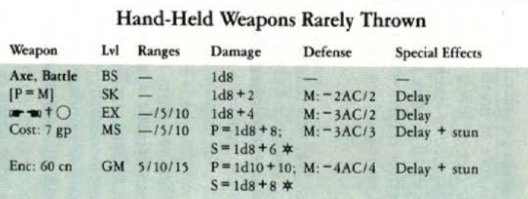 |
| An example of the first draft converted to 5th Edition |
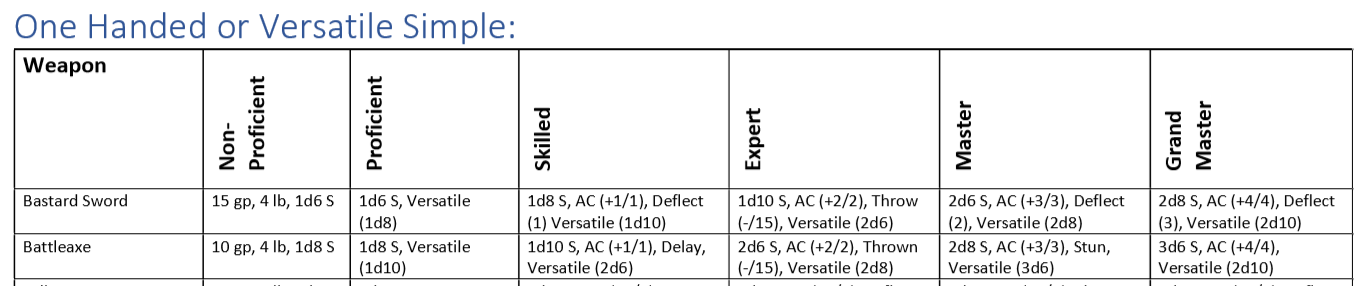 |
| An example of the annotated statblock version |
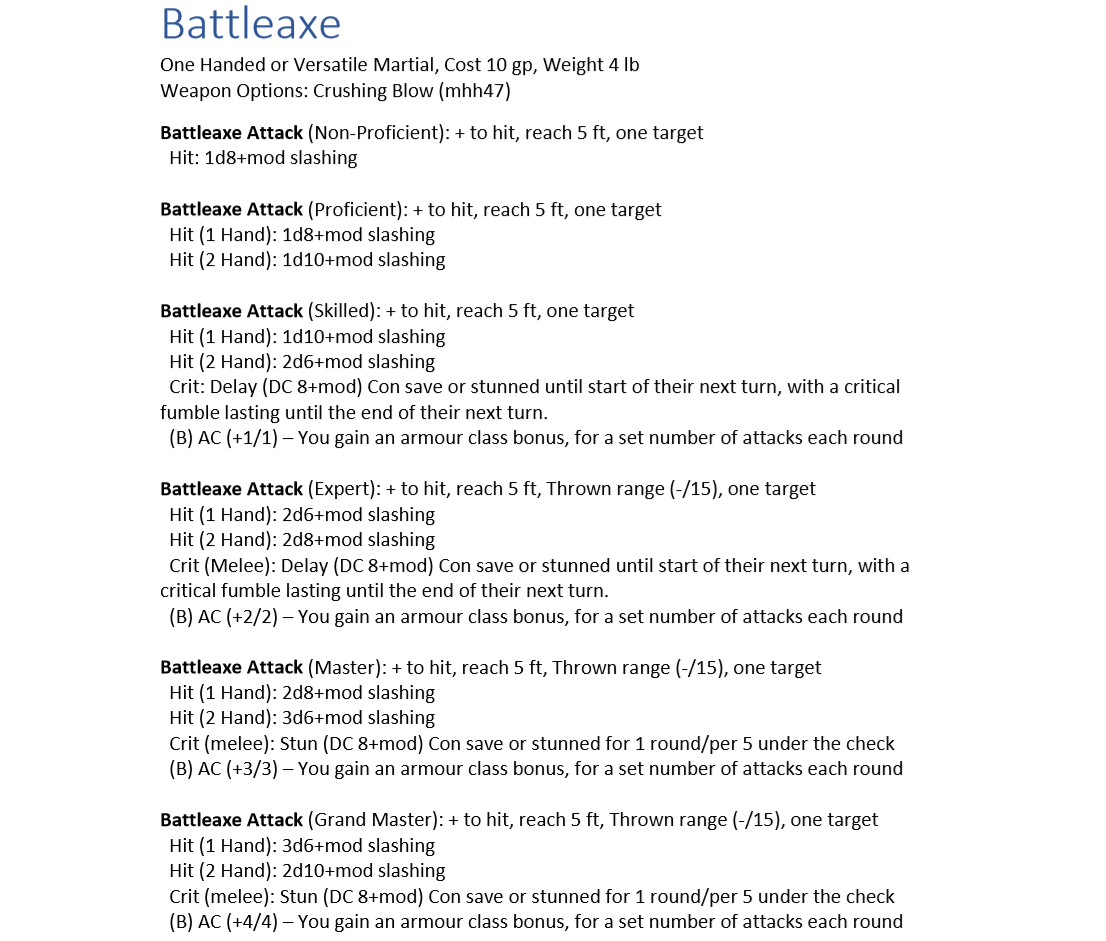 |
The original version of weapon master had only five levels of mastery merging Non-Proficient and Proficient as Basic Skill.
What I did was take the concepts in this of damage increase, defensive and special effects and bring them over into a new version of the weapon mastery laid out in a different style that was easier for me to read.
- Weapon: This is the name of the weapon.
- Non-Proficiency: This is the cost, weight, base damage and abilities a wielder who is not skilled in the weapon can use.
- Proficient: This is the damage and abilities available with proficiency. I have introduced changes where some aspects of the weapon can’t be used without proficiency.
- Skilled, Expert, Master and Grand Master: Each further upgrade of the weapon provides more damage or abilities.
The table is a basic breakdown of how the weapon works, I have also included a detailed breakdown per level of proficiency as well. This details how all the abilities work.
- Here we see the following mechanics:
- Versatile – Shown as Hit (1 Hand) or Hit (2 Hand) depending on how you are wielding it. This is one of the changes to non-proficiency that you have to be trained to use.
- Crit: Delay – A special critical hit option that on this weapon is only usable when in melee and not when you throw it.
- Crit: Stun – A special critical hit option that on this weapon is only usable when in melee and not when you throw it. This is an upgraded version of the Delay effect.
- (B) AC (+#/#) – This is a special bonus action you can use on your turn that increases your armour class (ability to avoid bring hit) by the number next to the plus sign, for the next attacks up to the number after the slash.
So a character who is skilled with the Battleaxe need only record the skilled section of the weapon on their character sheet.
How can I get Weapon Mastery - In my campaign I have characters starting out with Proficiency in weapons as indicated in their class. This is a good baseline for characters and provides the basics to the campaign. There are two ways to gain weapons mastery. The first is with character levels as part of gaining a level, and the second is with downtime.
Then if your a fighter you gain 4 weapon proficiencies at level 1, a barbarian, paladin or ranger gains 2 proficiencies, and all characters gain an extra proficiency for every three class levels they gain.
Each proficiency can be used to upgrade your knowledge with one weapon. There are currently 58 weapons detailed for my players to use.
A character can only advance the proficiency with a weapon if they are in the correct Heroic Tier of play. Tier 1 (Levels 1 to 4) can increase to skilled, Tier 2 (Levels 5 to 10), to expert, Tier 3 (Levels 11 to 16) to Master and Tier 4 (Levels 17 to 20) to Grand Master. Note - This has changed in the latest update.
The other way they can gain weapons mastery is to spend downtime to learn a weapon. This is only a matter of time and money. Find a teacher in one of the settings gladiatorial arenas and they will teach those who prove they are worthy heroes of the nation.
See the main Weapons Mastery Page for links to all weapons, details on all qualities and options.
What other elements use Weapon Mastery - So the elements that I have working Weapon Mastery into are Downtime, Secret Crafts, a Feat, and a Fighter Archetype.
I use Downtime and Secret Craft mechanics in my game world that are designed to be roleplaying elements, though they are still a work in progress. Players are expected to work with my as the dungeon master to detail their downtime in relation to the teacher.
The secret craft option is to limit proficiency of skilled and above to members of the secret craft, and the downtime mechanic makes the use of the proficiency points have a time and cost constraint. From the perspective of Weapons Mastery it is a discoverable aspect of the game, finding a teacher who is willing to teach you can be a journey in itself.
The feat is based on the weapon master feat in the players handbook, but goes in a different direction and is now only available to members of the secret craft.
The fighter archetype is also linked to the secret craft, but is also available as a base archetype in my world for fighters. It focuses on improving your abilities with Weapon Mastery and you truly become a Weapon Master that it is named after.
Designing Weapons Mastery - After a year of using weapon mastery in my games, I am happy with how this updated version turned out. It might need a few tweaks and changes over time, especially to make weapons more unique (otherwise why have two weapons with the same stats) and I have chosen to take the fully compiled list off my website so it is now a discoverable element of the game. Not all rules known upfront can introduce surprise back into the adventure.
With updating the items, and working through what is a proficient which includes changing around some of the damage values from what the base rules have for non-proficient use adding more weight to gaining proficiencies.
Planned Weapon Progression for simple weapons 1 => 1d2 => 1d4 => 1d6 => 2d4 => 3d4 => 2d6 => 3d6 => 2d8
Planned Weapon Progression for martial weapons 1d6 => 1d8 => 2d6 => 3d6 => 2d8 => 2d10 => 3d8
Weapon Mastery 2.0 – Redesign - After working with weapon mastery rules for two years I have rebuilt it for a more simple stylised design that is easier to expand and work with. Here are the basics of what I have done any why.
- Weapon Mastery Non-Proficient – Attacks are with disadvantage, and damage is halved rounded down. Non-Proficient use does not grant access to most of the weapon special properties.
- Why changes to Non-Proficient – I wanted there to be more of a challenge in relation to using using items your not proficient with.
- Weapon Mastery Proficient – This is the standard weapon stats from sourcebooks.
- Weapon Mastery Skilled – Weapons do an extra dice of damage. Gain abilities to activate as a bonus action on your round, or a reaction.
- Weapon Mastery Expert – You gain an expertise on your attack, and weapons do an extra dice of damage. Abilities with weapons improve. Can use weapon options with this weapon.
- Weapon Mastery Master – Your gain advantage on your attack, weapons do an extra dice of damage. Abilities and Options improve.
- Weapon Mastery Grand Master – A natural 1 counts counts as a critical hit, and if both dice deal a critical hit, then all dice in the attack are maximised. Weapons do an extra dice of damage. Abilities and Options improve.
- Beyond Grand Master in Weapon Mastery – While not possible to learn at this level, some abilities and magical items might push skill above grand master, and if it does it adds an extra dice of damage and improves abilities and options as per the weapon progression.
Weapon Mastery 3.0 – Blog to Website - Weapon Optional abilites become groupings that you can learn from, instead of indivually assigned weapons to each option. Magical items that increase the number of dice for the damage do so via increasing the character mastery with the item.
Mystara of the Five Spheres - Part 9 - Setting Overview
This the campaign that I run for the Wrath of the Immortals campaign.
What is Mystara? Mystara is the D&D setting when there were two D&D franchises. Dungeons and Dragons (D&D) vs Advanced Dungeons and Dragons (AD&D). AD&D started with Greyhawk, D&D started with Mystara.
The Mystara setting encompass The Known World, The Hollow World, Red Steel and the Savage Baronies, and is where Blackmoor was originally based.
When AD&D moved to 2nd edition they brought the world of Mystara to that edition so it then spanned both version.
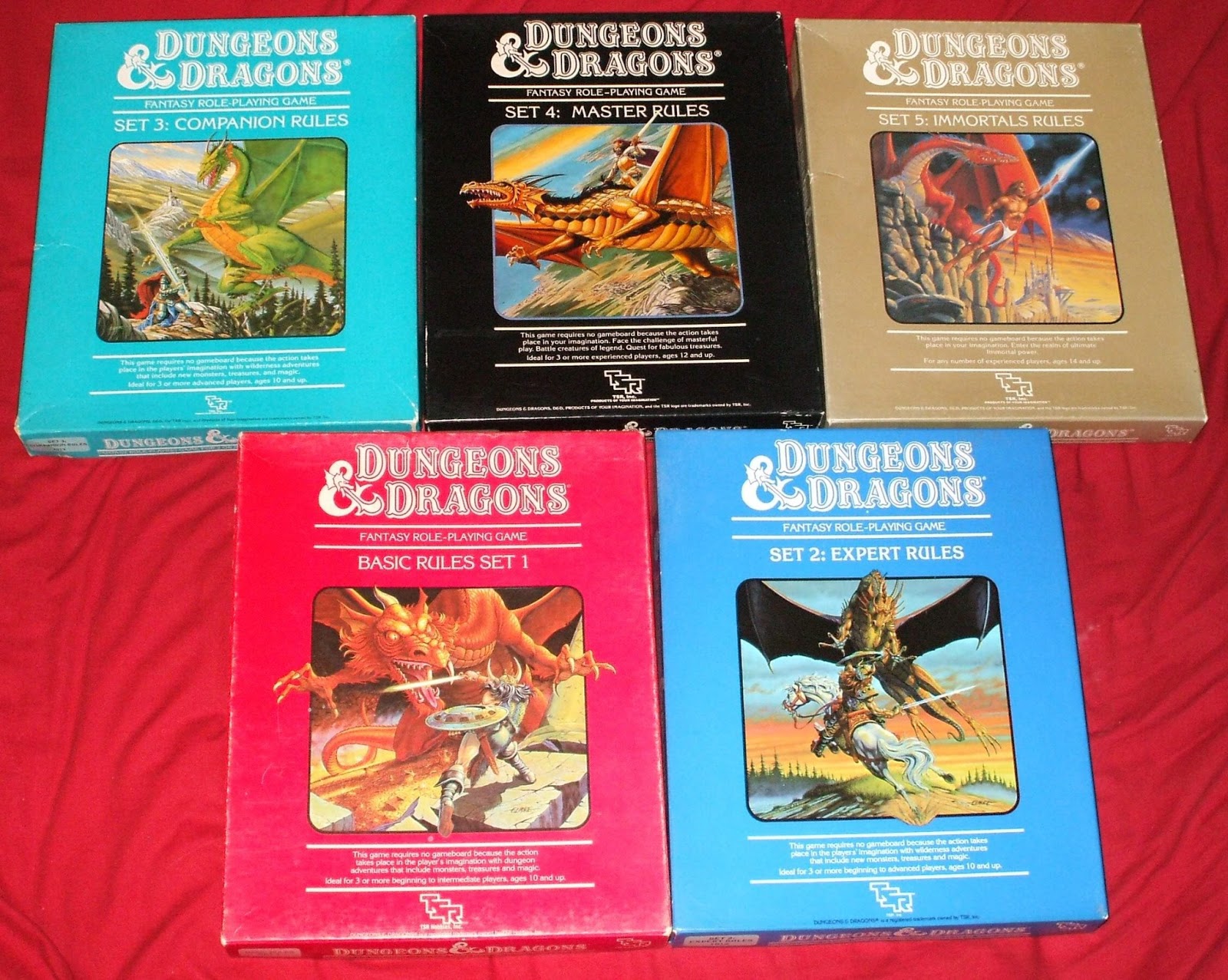
| What is BECMI | |
|---|---|
|
This is know as the Basic Expert Companion Master Immortals (or BECMI) ruleset. Known mainly for the the following differences vs Advanced Dungeons & Dragons:
|  |
| What is the Rules Cyclopedia | |
|
The Rules were all condensed into a single volume called the Rules Cyclopedia which is an good resource having the majority of the rules from the five different books, omitting the Immortals rules (for future release as “Wrath of the Immortals”) and removing the world references and adventures present in each boxed set. | |
Why did I choose this setting? - I have run this world for 30 years, in every version of Dungeons & Dragons and this is how I have changed the setting to make it my own for 5th Edition based on player choices and how things have turned out in games. With discussion from the players we wanted to get everyone out of their comfort zone and experience different characters and races that they would not normally take.
Original Constraints - The original concept for this episodic campaign was as follows:
- Each player has a character in each Gazetteer (country) of the setting.
- They can’t choose the same class twice.
- The need to choose different race options.
- They need to choose different subclass options that have not already been used in the campaign.
- They cover the first 4 years of the campaign world from AC 1000 to 1004 and each year gives them a character level.
- They get a random item roll on the treasure table each to share amongst themselves and 500 gp for each game year completed.
- Using 5E ruleset and published books by Wizard of the Coast
- All half-races are sterile and come from magical or divine intervention, each Half-Elf, Half-Orc, Tiefling or Aasimar is unique and a dead point on their family tree. Preferred not to be in game and requires Dungeon Master approval before being allowed to play.
- Dragonborn are the littermates of a dragon born to be their servants.
- Unearthed Arcana to be allowed with GM permission only and will be denied in most cases. Though you are welcome to try and surprise me with how well it fits with the campaign, the setting and the storyline.
- It is expected that they will have 4 to 8 sessions in each of the Gazetteer regions and learn the fluff of the countries in the setting and along the way while getting a feel for each of the character options. The first one went a little overboard and tested out some of the other rules including training and other downtime activities.
- Once they have completed the tour of the “Known World” region they will then start on the “Wrath of the Immortals” campaign with characters taken from all of the completed mini campaigns they participated in.
Updated Constraints - Version 2 - This concept needed to be refined and now the setting has becomes the following:
- Each player needs to provide an annotated stat block design to highlight were ability and items were obtained.
- Each game year the characters advance 1 level in the 12th and final month of the year. The year of the game world determines the level.
- Characters are point buy only.
- Redefined races based on the five element concept and needs to be consulted with GM to determine homeland, background, racial and class options.
- Unless you are a practitioner of a Immortal or a Pantheon there are no death saves, and you can’t be brought back from the dead. Reaching 0 hp is death.
- Magical items are all customised – they have an unattuned, attuned, awakened and exalted state.
- The adventures are all incorporated into the timeline, providing hooks in each nation each year. This includes all published BECMI and 5E material.
- Secret Crafts are incorporated into the storyline and will be a big part of the 2020 campaign.
- Weapon Mastery will be cleaned up and made available.
The World of Mystara - This is the gaming world where all the fun takes place. This world has a history of a great cataclysm the changed the seasons and brought down all the great civilisations at the time. This was BC 3,000. The game is centred around the eastern end of the continent of Brun and the islands in between it and the continent of Skothar. This is the focus of the campaign.
The Continent of Brun - The continent of Brun has two main regions that come into play in the storyline. The Kurish Massif down to the islands along the coast form the region known as the Known World.
The Wyrmsteeth mountains up to the White Sea is the location of the Norwold region.
To the right across the sea of dawn is the heart of the Alphatian Empire.
The Known World Region - This is the centre of the campaign, characters are expected to come from one of these countries and share the common tongue of Thyatian. This may not be a starting language for some and something they have learned as a necessity by the time they reach 5th level and become a national hero.
The region of Mystara called the “Known World” where the Gazetteer series is based.
- The Gazetteer Series are as follows: (with cultural similarity)
- GAZ1 – Grand Duchy of Karameikos (Roman style mixed with Eastern European)
- GAZ2 – Emirate of Ylaruam (Arabic style ruled by clerics)
- GAZ3 – Principalities of Glantri (Wizards as nobility)
- GAZ4 – Kingdom of Ierendi (Pirates, advanced navy and holiday resorts and ruled by a contest for King and Queen)
- GAZ5 – The Elves of Alfheim (Home of elven culture)
- GAZ6 – The Dwarves of Rockhome (Home of dwarven culture)
- GAZ7 – The Northern Reaches (Kingdom of Ostland, Kingdom of Vestland, and Soderfjord Jarmdoms)
- GAZ8 – The Five Shires (Five differing halfling shires)
- GAZ9 – Minrothad Guilds (Guide Caste culture)
- GAZ10 – The Broken Lands (home of the orcs, goblins and similar humanoids)
- GAZ11 – Republic of Darokin (Renaissance Europe)
- GAZ12 – Ethengar Khanate (Mongolian horsemen)
- GAZ13 – Shadow Elves (the centre of the lands below the ground)
- GAZ14 – Atruaghin Clans (American tribes)
- GAZB (for BOX) – Empire of Thyatis (Roman) / Empire of Alphatia (Greek)
The Known world has cultures and a level of technology development that resembles the Europe of our Earth around 15th century. The known world does not have gunpowder or the printing press, but in many other ways the two worlds are similar.
Late-medieval feudalism is the most common system of government: A nobleman, usually a powerful warrior, rules a region of land, occupying a stronghold (often a castle) at its capital, guarding the region and enforcing his laws with soldiers normally drawn from the local population. The peasants of his region pay him taxes and services; he, in turn, protects them against invaders and evildoers.
Just as the peasants serve the noble, so too does the noble serve a greater ruler, a king or emperor. The petty noble supplies taxes to the greater ruler, and in times of war supports him with soldiers and additional money, and often must campaign with his king. The greater ruler, in turn, is obliged to protect the lesser ruler’s claim to nobility, and to help protect the lesser noble in times of invasion. The oath of mutual services and support sworn between them is known as the oath of fealty.
The Norwold Region - This is not a starting region, but contains the home of the high elves, dragons and a few other nations. If and when players want to start looking at setting up their own nation, here is where they will have the best chance of doing so.
| What is the Wrath of the Immortals? | |
|---|---|
|
The wrath of the immortals is a campaign about a great war that shakes the foundations of the known world and the reality of the world itself. This will put all the characters into a morality of what side should they take as any of them can be seen as correct, when you look at how they view the world. This will be taking place while all the other elements of the setting are taking advantage of the conflict to put their own plots in motion, and this is the basis of including all the 5E supplements happening at the same time. I have also re-written it to take 20 years from initiation to completion in line with the characters levelling. |
|
What is Immortality? - Immortality in this setting is who represents the Gods of the world. Totalling 166 at the start of the storyline AC 1000.
This storyline does include the possibility of characters achieving immortality, the existing immortals will be sourced from the BECMI material and those found on the Vaults of Pandius website then adapted to 5th Edition.
Further Information - I intend to have a variety of blogs, which I will expand over time on the setting as adapted to my storyline. (Update – 1,500 posts so far)
- Information on this setting can be found at the following:
- http://pandius.com/ – for information on the setting
- http://thedarkelf007.com/dungeons-dragons – for my campaign which this series is based on
Mystara of the Five Spheres - Part 10 - Timeline Overview
I have run many games over the last thirty years, and the games that were most loved by he players were ones that included rumours and stories about events happening around the world. It is not a simple task to set this up, not knowing what your players will be interested in. There are a few things to consider when building a timeline for a campaign:
This is a discussion on the setting as well as what I am doing with the timeline. It is the first in a series of posts about my changes and how they affect the games I am running in Mystara.
What is the Setting? - The setting is based around the Mystara world, also referred to as the Known World and Hollow World (with adventures in Blackmoor) created as the core setting for Dungeons and Dragons while Greyhawk, Forgotten Realm and Dragonlance were the settings for Advanced Dungeons and Dragons. During 2nd edition Advance Dungeons and Dragons a few supplements made their way into the Mystara brand including Red Steel.
The core concept of the setting is that it is based around a idea of real world cultures adapted to the fantasy setting. This means that new players, or players who have not encountered a setting can be given a reference such as Mongolian = Ethengar or Indigenous American = Atruaghin Clans, and lastly Roman = Thyatian culture.
- This will cover the following nations and the related events:
- Alfheim (Kingdom of) – The nation of forest elves located inside the borders of Darokin. The elves have a spiritual link with the land.
- Alphatia (Empire of) – This covers a large region from the Continent of Alphatia, Bellrissia and the Eastern side of the Isle of Dawn, and many islands in the region. They have a greek feel to their cultural identity.
- Atruaghin (Clans) – This is a group of five clans with many tribes in each clan. They are largely human with a number of animalistic and monstrous races among them as symbols of their tribal totems.
- Broken Lands – A grouping of undesirable Orc, Troll, Goblinoid and Gnoll nations forced out of other nearby lands.
- Darokin (Republic of) – A renaissance style country based around trade and guilds.
- Ethengar (Khanates) – A group of mongol like clans (called Khan’s) each with their own tribes, lead by a single great Khan.
- Five Shires – The home of the halflings with five separate shires to represent each of the five elements of their society.
- Glantri (Principalities) – A nation of wizards, ruled by wizards, for wizards. Each principality is its own culture.
- Hollow World (Nations of) – A Group of nations based on the history of the setting, each resembling a real world.
- Ierendi (Kingdom of) – A holiday destination for the wealthy, but also home to pirates and those who don’t wish to be disturbed. They are the corsairs of the sea.
- Karameikos (Grand Duchy of) – A splinter nation of Thyatis, a young nation of thirty years still finding its feet with a roman style rule over eastern European peasantry.
- Minrothad (Guilds of) – A nation of sea traders and guilds, much like Darokin.
- Northern Reaches – A set of interconnected nations of Ostland, Vestland and the Soderfjord Jarldoms. They follow a norse style mythology and a viking like culture.
- Norwold (Kingdoms of) – This includes the Heldannic Territories, Wendar, Wyrmsteeth and Denogoth.
- Rockhome (Kingdom of) – The home of dwarves. Most at home underground.
- Shadowlands – This is a connected series of kingdoms for all the races of darkness that dwell under the earth.
- Thunder Rift (Plane of) – A continent sized plane connected to the world.
- Thyatis (Empire of) – A large nation that incorporates the western side of the Isle of Dawn, the northern part of the southern continent and a substantial part of the known world.
- Ylaruam (Emirates of) – A series of smaller nations united by the beliefs of their god and a better way of life.
Does the Setting have Special Events? - Each game year special events are due to pop up in various nations of the world. These events represent the published works in the setting as well as the newly released 5th Edition modules that I have adapted to the setting.
Certain events in the game are expected to be long lasting keystone storylines that will shape the world over the timeline.
The original concept of this multi-campaign arc was to have mini campaigns that lead to the start of the core campaign, but that fell short when players suffered from changing their characters every two months (4 sessions) and lost connection to them, so when the actual campaign started they were gone.
How much can players change - The players will be responsible for many of the outcomes, either through choosing to be part of it, or allowing it to happen somewhere else.
When they are participating in the event, how they act, what they do, and how they leave it will become instrumental in how they event concludes.
This does not mean that all events have happy endings. It is possible that the players can be responsible for the worst events of the timeline.
Will it be true to the official timeline - The official timeline is of Wrath of the Immortal is set between AC 1004 and AC 1009. This is a re-write of the timeline to have the events happen from AC 1000 to 1020 with each game year proving 1 character level.
Some historical events will be added as I go to clean up this version of the world and help the players write their own mark on the world. Each of the posts about that game year will have impacts on the relevant nation, and may introduce new or missing nations to the gazetteer list.
How can you make the setting appear vibrant and alive - This will be done by having each years events planned out in advance so the players can hear about them as they occur as rumours, plan some of them, and have their backstories be relevant to the ongoing storyline.
No character is a vacuum. Each adds to the narrative. The timeline is where all the campaigns, characters and stories will be tied together and become the glue for the campaign. I am hoping that it will stick and become something worth reading.
Mystara of the Five Spheres - Part 11 - Magical Items Overview
What are magical items - In the D&D game, and many of the variants such as Pathfinder, characters can obtain enhanced equipment that provide them with a new or enhanced capability beyond what they could do normally.
Why are my items different? - I have chosen to modify my items to make them part of the five element concept and allow them to grow with the character and become something more than it was, to inspire legends.
This also provides a way for mystery to return to the game. I have quite a few players who have run the game themselves and can’t help but look up the “Stats” or call them out once they think they know something is.
Each item will have a unique ID in my world, and with it a backstory. While this backstory may not be defined as the item is found, it will be expanded as the characters investigate further into the items history. Sometimes this will be created by the players, and sometimes by me.
A player can conduct a research activity to discover (or choose) one fact about their item that is added to its description and lore.
What are the rarities of items? - Magic is separated into different scales of magic that can be used by characters, and these have been tailored to the five element theme as well to make them more descriptive and fit the setting better.
- Standard – These are the items that are non-magical and while not always available are the cheapest way to increase a characters versatility and capability.
- Common – lucky to find in hamlets and villages.
- Uncommon – lucky to find in villages and towns.
- Rare – lucky to find in towns and cities.
- Very Rare – lucky to find in cities and major trade hubs
- Legendary – usually require a quest to find
- Artefact – never found by accident. While they can be considered a magical item, artefacts will be using a different set of rules and abilities.
An example of this is a sword’s base level is you gain an attack with it, when it gains levels of power, it can provide an upgrade to the chance to hit, the damage, or upgrades to other abilities such as initiative with weapons of warning, or new capabilities such as ability to automatically return when thrown and the ability to cast a spell.
What are the item design features? - The item features are taken from the Dungeon Masters Guide table for Creator, History, Minor Property and Quirk. Each item will also be given a unique name to go with the number to represent its story in the game.
These are used as a guideline to build a unique item for the campaign that then has a backstory that can be investigated with characters spending downtime on research. Two items with the same features may have a completely different description and may even have other powers based on that.
Magical Items and Teleportation Effects - Any item that interacts with another plane of existence, does not teleport, and cannot be put into an extra dimensional space. This is the default rule for the setting, and characters would need to research a specific item if they wish to learn how to bypass this restriction for that item.
Relics - Relics are an addition to the magical items that provide bonuses depending on the race of who is using it. They can have any power level from common to artefact, granting addition powers based on what they are.
What about Intelligent Items? - Intelligent items do exist, and they are brought about by heroes investing in their use, or the intervention of the immortals.
How many Attunement Slots do I get? - A character in my world of Mystara can attune to 2 items plus the Tier of the character (starting characters get 3 attunement slots). I am using the Tier system as a milestone in how much magic you can maintain.
What else is different about attunement – When you have attuned an item, its standard item power is not usable on another individual while you remain attuned.
Artefacts have their own attunement slot, and you can only have one artefact attuned at any time. There are specific times this rule is broken, but that is not player or character knowledge in my game.
And what about those Artefacts? - Artefacts have a few categories of power, each of these can have the same levels of power shown earlier.
- Minor – These are the items created through mortal means.
- Standard – These are the items created through mortal means.
- Major – These are the items created through mortal means.
- Vestige – These items have been infused with Immortal power.
- Immortal – these items are Immortal power and can damage mortals who wield them.
What are the power level of items? - Magical items can gain power based on what they were designed to do, how they have been used, and places they have been.
- Standard Item – All expendable items can’t progress from this level, and this is the functionality available without attunement. This can be identified with a short rest.
- Attuned Item – This is an investment in on character that allows you to access the higher level powers of an item. These powers can only be discovered with attunement or casting Identify on the item.
- Awakened Item – This is a unique advancement to the item that has formed a bond with the character. It is possible for the item to gain a level of sentience with this. It may have unique conditions on the duration of the awakening, who can use it, and what can end it.
- Exalted Item – This is the stuff of legend, the item extracts a price, but becomes more powerful.
- Artefact Item – The item has reached the end of its evolution, though there are separate power levels when talking about artefacts. Artefacts are not an evolution of an item, but a pinnacle of creation.
What is next? - I intend to deliver regular Thursday posts on the items held by my players as examples of what I have planned long term for this game.
I like my magical items to be more that just cookie cutter bonuses to be ignored by my players, I want them to be part of the history and lore of a setting. I have always enjoyed the feel of the setting when items don’t just appear in a vacuum and depending on who made them have different properties, appearance and story.
I intend to expand upon the five element concept of the setting into the workings of the magical items, but as to how that will work is still in a conceptual stage in the back of my mind.
Update: After doing this for close to a year, as of 2021 I started putting out the items in bulk to get through all the items my players can come across over the course of the campaign.
Mystara of the Five Spheres - Part 12 - Classes Overview
This is an series of articles on which 5th Edition classes are available in my campaign and where you will find a teacher. It starts out with Humans and Dwarves being the source of all classes, due to the other races still being in development so this will be updated as that expands as well. Expect to see additions due to those races over the next year or two. This is a long term project so I am not rushing to complete it, doing one sub race at a time.
Classes Available: Barbarian, Bard, Cleric, Druid, Fighter, Monk, Paladin, Ranger, Rogue, Sorcerer, Warlock and Wizard.
Barbarian - The Barbarian class has no rule changes except that the list of selectable paths are below.
- Path of the Ancestors
- Path of the Ancestral Guardian
- Path of the Battlerager
- Path of the Berserker
- Path of the Harrier
- Path of the Juggernaut
- Path of the Storm Herald
- Path of the Totem Warrior
- Path of the Zealot
Bard - The Bard class includes a ritual book as part of its starting option with two bard rituals that the character has also learnt of the players choice.
- College of Entropy
- College of Fey Magic
- College of Glamour
- College of the Jester
- College of Lore
- College of Swords
- College of Valour
- College of Virtue
- College of Whispers
- Greenleaf College
Cleric - Clerics gains their spells from the gods, and each sphere has gods associated with that sphere that can be selected as the source of the spells. Characters can either choose a Sphere (and associated god) or a religious organisation which includes a pantheon. All divine power comes from the gods.
Clerics start the game with a prayerbook, identical to a spellbook, and it contains the same amount of spells as a wizards, gaining two new known spells per level. They includes a ritual book as part of its starting option with two cleric rituals that the character has also learnt of the players choice.
- Spheres and Domains:
- Sphere of Energy (Fire, Light, War) - other domains (Arcana, Hunting, Travel, Zeal)
- Sphere of Matter (Earth, Forge, Nature) - other domains (Beer, Creation, Dragon, Hunt, Moon, Mountain, Strength)
- Sphere of Thought (Air, Knowledge, Trickery) - other domains (Balance, Beauty, Justice, Labyrinth, Solidarity, Tempest)
- Sphere of Time (Life, Speed, Water) - other domains (Cat, Clockwork, Ocean, Prophecy, Repose, Time)
- Sphere of Entropy (Darkness, Death, Grave) - other domains (Ambition, Apocalypse, Blood, Corruption, Lust, Madness, Tyranny, Void)
General Pantheons: - The general pantheons are more based around nature and the environment that any one particular race or culture. These pantheons represent various environments around the setting and are good places for druids and rangers to find their gods (Immortal) or simply follow the concept of the Pantheon.
- Forest - for all creatures of the woodlands and animalistic races. All patrons of the forest, nature and creatures of the forest are found here.
- Ocean - for all creatures of the ocean, both on its surface, and below the waves. Each of the patrons of the sea should be here.
- Radiance – Followed mainly in the Glantri region. Not really considered a religion by its followers.
- Shadowlands - for all creatures who live deep under the ground. All the underground races were lumped together as there is some overlap in the storylines, so it sort of fits.
- Sky - for all creatures who live in the sky and mountain tops. This was a good place for all patrons of flying creatures and contraptions.
Racial Pantheons - These are pantheons that are more to do with a character’s race than where they are or what sort of environment they prefer. They usually feature racial heroes who have become gods.
- Dragonkin – Followed by the Dragonborn, Lizardfolk, Kobolds and the Dragons. There are more dragon gods than I expected, though there are references to a previous pantheon of dragon gods that are not listed.
- Dwarven & Gnome – Followed by dwarves and gnomes. All of the Dwarf and Gnome patrons ended up here as there was not enough to stand on their own in the first cut of the gods.
- Elven – Followed by elves. All elven immortals and their patrons ended up in here.
- Genasi – Followed by Alphatian Empire and Genasi everywhere. All the gods are titled. As a major player in the world they have one of the biggest pantheons and it helps show why they struggle to get traction when you have a lot of voices giving directions.
- Halfling – Followed by Halflings. Mainly halfling patrons and halfling that became immortals.
- Makai – followed mainly in the Ierendi and Minrothad region.
- Traladaran – The religion of the Karameikos subjugated people and can be found where the Traladaran people migrate to.
- Ylari – Followers are where you find the Ylari people, Alasiyan and Makistani.
Cultural Pantheons - these are pantheons that surpass races and embrace a culture no matter the race involved.
- Norse – the Norse religion, followed in the region and by Heldannic people and others in the Northern Reaches.
- Ocean Guild – followed by sea traders, the guilds and the Minrothad region.
- Outcast – Followed by monstrous races such as Orcs, Trolls and Giants. A good catch all group for these races and those who support a more conquest themed religion.
Known World Pantheons - These are the pantheons that are founded in the nation or is the cultural source of the human religion. They usually feature heroes of the nation.
- Atruaghin Clans – Followed by the clans only in the region.
- Darokin – Followed by caravan trader, the republic and their diplomats.
- Ethengar – Followed by the people of Ethengar, where they might be found.
- Thyatian – the religion of Thyatis and Karameikos, based around roman ideals and using descriptors for the gods. Followed by Thyatian people everywhere.
There are more pantheons in the greater world, but those are not starting pantheons for player characters and will be explored in the cleric update.
Druid - Druids start the game with a craftbook, identical to a spellbook, and it contains the same amount of spells as a wizards, gaining two new known spells per level. They includes a ritual book as part of its starting option with two druid rituals that the character has also learnt of the players choice.
- Circle of Dreams
- Circle of the Forest Kingdom
- Circle of the Land
- Circle of the Moon
- Circle of the Shapeless and Prime Terror
- Circle of the Shepherd
- Circle of the Stones
- Circle of the Tree of Life
- Feyfriend Circle
Fighter - The Fighter class has no rule changes except that the list of selectable martial archetypes are below.
- Arcane Archer
- Banneret
- Battle Master
- Cavalier
- Champion
- Clacking Mercenary
- Edjet
- Eldritch Knight
- Ghost Knight
- Griffon Knight
- Hospitaller
- Knight Surgeon
- Samurai
- Shield Bearer
- Sword Dancer
- Weapons Master
- Woodlands Cavalier
Monk - The Monk class has no rule changes except that the list of selectable traditions are below.
- Way of the Cobalt Soul
- Way of the Drunken Master
- Way of the Elements
- Way of Iron
- Way of the Kensai
- Way of the Long Death
- Way of the Open Hand
- Way of Shadow
- Way of the Sun Soul
Paladin - Each paladin receives their spells from one of the Spheres (and specific associated god) or from a religious organisation (or a pantheon)
Paladin start the game with a prayerbook, identical to a spellbook, and it contains the same amount of spells as a wizards, gaining two new known spells per level. They includes a ritual book as part of its starting option with two paladin rituals that the character has also learnt of the players choice.
- Oath of the Ancients
- Oath of the Ascetic
- Oath of Battle
- Oath of Conquest
- Oath of the Crown
- Oath of Devotion
- Oath of the Eagle
- Oath of the Giving Grave
- Oath of Mercy
- Oath of Perfection
- Oath of the Radiance
- Oath of Redemption
- Oath of Thunder
- Oath of Vengeance
- Oathbreaker
Ranger - The Ranger class includes a ritual book as part of its starting option with two ranger rituals that the character has also learnt of the players choice.
- Beast Master
- Explorer
- Fey Hunter
- Gloom Stalker
- Hidden Guardian
- Horizon Walker
- Hunter
- Monster Slayer
- Unicorn Charger
- Vampire Slayer
- Zobecker Scout
Rogue - The Rogue class has no rule changes except that the list of selectable rogue archetypes are below.
- Arcane Trickster
- Assassin
- Duellist
- Fixer
- Inquisitive
- Mastermind
- Scout
- Swashbuckler
- Thief
- Whisper
Sorcerer - The Sorcerer class includes a ritual book as part of its starting option with two sorcerer rituals that the character has also learnt of the players choice.
- Divine Inspiration
- Divine Soul
- Draconic Bloodline
- Dryad Bloodline
- Elemental Essence
- Lycanthropic Bloodline
- Mazeborn Bloodline
- Nerid Bloodline
- Norn Bloodline
- Nymph Bloodline
- Pyromancer
- Runechild
- Satyr Bloodline
- Serophage Bloodline
- Shadow Bloodline
- Shadow Magic
- Storm Sorcery
- Wild Magic
Warlock - The Warlock class includes a ritual book as part of its starting option with two warlock rituals that the character has also learnt of the players choice.
- Pact of The Archfey
- Pact of The Celestial
- Pact of The Black Woods
- Pact of The Fiend
- Pact of The Genie Lord
- Pact of The Great Machine
- Pact of The Great Old One
- Pact of The Hexblade
- Pact of The Light Eater
- Pact of The Oracle
- Pact of The Undying
Wizard - The Wizard class includes a ritual book as part of its starting option with two wizard rituals that the character has also learnt of the players choice.
- Angelic Scribe
- Bladeslinging
- Doom Croaker
- Dragon Masks
- Elementalist
- Geomancy
- Necrophagy
- Ring Warden
- School of Abjuration
- School of Artifice
- School of Blood Magic
- School of Clockwork
- School of Conjuration
- School of Divination
- School of Elven High Magic
- School of Enchantment
- School of Entropy
- School of Evocation
- School of Illumination
- School of Illusion
- School of Necromancy
- School of Transmutation
- School of Void Magic
- Timekeeper
- War Magic
Mystara of the Five Spheres - Part 13 - Downtime Overview
Introduction to Downtime - This is a part of my 5th Edition Dungeons and Dragons Mystara conversion series of articles looking at what I have done to bring the original setting of Mystara to my tabletop group.
D&D 5th edition has introduced a new mechanic to the game called Downtime which is dealing with events over a week of game time. What this does is allow for extending out the game world so all events for a character does not happen in a single week.
In the previous versions of the game, you adventure, level mid adventure, and keep going. This means that from 1st level to 20th level in the game could all be done inside a month of in world time. And with some adventures this is almost a requirement to complete them in time.
Downtime can be found in the players handbook around crafting, practising a profession, recuperation and training.
The dungeon masters guide introduces more for building a stronghold, carousing, crafting a magical item, gaining renown, performing sacred rites, running a business, selling magical items, sowing rumours, training to gain levels.
Xanathar's guide revisits some of the downtime, and introduces some more, so it details Buying a magic item, carousing, crafting an item, crime, gambling, pit fighting, relaxation, religious services, research, scribing a spell scroll, selling a magical item, training, work.
Grouping of Downtime Activities - In my game world I have grouped my downtime activities to help sort out the actions.
- Item Activities - The buying, creating and selling items.
- Festival Activities - See Forest Kingdom Campaign Compendium from Legendary Games for more details.
- Learning Activities - Weekly tasks to improve your characters skills from knowledge, language, tools, levels, weapon and secret crafts.
- Lifestyle Activities - For everything about improving your characters well being from fun to recovery.
- Wealth Activities - Ability to earn money outside of items.
Why I introduced House Rules? - I thought the costs and times involved in some of the training were too much for the characters as the ability to learn a language in the players handbook takes 250 days, costs 1 gp per day.
Xanathar's Guide rewrote it to be ten weeks reduced by your int modifier and costing 25 gp per week so costing up to 250 gp. The time taken has been reduced to 70 days maximum, but could be as little as 35 days. Each week a complication was possible to happen ten percent of the time.
My version of the learn a language changes it to 4 weeks (28 days) with a attribute check once per week and 25 gp per week. If you fail the attribute check, the following check is at one less making it easier over time. You still have to pay for each attempted week, even if your not successful. The attribute you use is determined by the teacher as agreed between the player and myself. I have changed the complication rules to have a 5% accumulative chance per week, with a character having the ability to accept a complication instead of a failure.
What this gives to the game, is a way to pass time for the characters, get them though periods of inactivity and extend out the time between levels so the storyline feels more organic.
As an addition to learning the language, the character can spend the week teaching the language instead earning half the cost. This is true for each of the learning options.
My house rules focuses on the learning aspects of downtime.
Training for Language or Tools - Besides learning a language, I have moved this into this learning category tools and dialects. Tools are basic proficiencies that you can learn. Dialects are variations on the language that are unique to a group of people (usually a nation) where you need to make an insight roll to understand the nuances of the conversation, with the intelligence score of the speaking being the base DC. I have also make it only take a week to learn a dialect so it is not too punishing for players.
There are a lot of language in the setting I run so this provides a way for characters to learn those languages.
Training to Gain Levels - The main difference for gaining levels is that tiers of play take 2 weeks per tier instead of 10 days. While an extra four days a tier might not seem like much, but it does make the characters spent time in roughly month blocks making timekeeping a lot easier in the long run.
I have also added mentor requirements, which can relate to specific locations around the game setting so travel time will also be added to it. This does mean that time sensitive storylines should not expect the characters to level if they want to meet tight deadlines.
Training to Learn a Secret Craft - This is a new type of society that I have taken from the BECMI Gazetteer sourcebook Principalities of Glantri and expend to make it more useful to the setting. These will be described further in another post.
Training to Learn Weapon Mastery - Very similar to the Secret Crafts, learning increased proficiency with a weapon takes longer the better you want to get with the weapon. I have linked weapon mastery with secret crafts.
Also some weapons have optional abilities you can learn as well.
Training to Learn a Spell - Instead of knowing every spell in your spellbook, and learning a spell by scribing into your spellbook. I have an ability to learn a spell without instruction and halving the time if they have an instructor. This is for spells outside those learnt by gaining a level.
As all the prepared classes in my world have to learn spells like wizards, this is an important rule. And all spellcasters gain access to ritual spellcasting being able to cast a spell via an ability check also need to learn the ritual to be able to utilise it.
This leads back to a flavour of learning that I wished to encourage in my games.
Additional Rules and why they are needed - While using this in play, we had a few issues of players who used Int as a dump stat crying unfair as it was harder for them to learn than those who had a higher Int. Well that was by design, but it was causing issues. So here are two variants I will be trying next time I run the downtime activities.
One roll for the whole of the downtime, representing the whole time.
A roll of a 1 means that a complication occurs and that may affect if it was completed or not.
Otherwise the amount you failed by equals the additional weeks required to complete the downtime, and its cost by the weekly value.
Every few months I check back over the rules and update them based
Mystara of the Five Spheres - Part 14 - Immortality Overview
Note: Meant for 20th level characters only.
The Petition - There are five paths to Immortality open to players (and some hidden paths). Any intelligent creature may try and earn immortality in any Sphere, although PCs should avoid Entropy for story balance.
This decribes how a character goes about petitioning the Immortals for a chance to join their ranks.
I have also done a GM reference on what happens at The Arrival for the Petition, which is not character information. Players should avoid this section.
Paths of Immortality - The other purpose for Immortals is to sponsor mortals that wish to join them. It is not an easy task, for more perish than ever succeed. One cannot become an Immortal without the help of a sponsor, and there is no guarantee a mortal will ever gain a sponsor. Once a mortal has obtained a sponsor, they must partake of a task to prove the mortal is indeed worthy. Once they start a task they become a Quester.
- The Path of the Dynast is for the Sphere of Time. The hero must prove themselves worthy by building a dynasty worthy of an Immortal. This task requires the hero to establish a long-lasting rule by the hero and descendants. The hero must populate the realm with enough people and build a capitol for the new realm. The other challenge of the Dynast is they must travel in time to help their descendants retain the realm built by the hero. The hero must quest for an artefact to accomplish this, then they are worthy of immortality.
- The Path of the Epic Hero is for the Sphere of Thought, must undergo a series of quests, first to find a powerful artefact of Thought. Then to destroy an artefact of Entropy. Then the Epic Hero must create a great weapon, train a worthy successor and finally complete an epic quest taking no less than five years to accomplish.
- The Path of the Paragon is for the Sphere of Energy, a test of creation and conquest. The hero must find an artefact of Thought, then create an entirely unique magical item that requires at least one impossible component. Once those are finished the Paragon must train no fewer than half a dozen apprentices and see them rise in power. Finally, the Paragon must challenge and defeat all wizards with 1,000 miles before they are eligible.
- The Path of the Polymath is for the Sphere of Matter demands its candidate partake a quest for an artefact that will force the hero to quest for it several times. Each time the hero attains the artefact, the artefact resets the hero back to 1st level of a different class with no memories of the past lives. The hero must then find the artefact again with a party with at least four different classes, until the fourth time when all memories and levels are returned. Then the candidate must build a monument of their achievement.
- The Path of the Conqueror for the Sphere of Entropy. (See GAZ10)
Note: - This is meant to be discovered only once a character reaches 16th level or above, only then is how it applies to a campaign discussed.
Ranks of the Immortals - In this setting the gods of the pantheon are all immortal of various ranks. Here are the gods I have available to my players and NPCs in my Wrath of the Immortals campaign.
There is another level called The Old Ones, but only the gods know anything about that one. The number in the brackets after the god represents their power level. The higher the number, the more powerful the god.
The overview of the gods details all the different names that I have for each of the gods that have been written up here, including what they are patrons of and what artefacts are relating to the setting.
- There are seven tiers of the gods:
- Hierarch or Rulers: These are the the ruling deities, they set the rules for which all other gods of a lower level must follow. Only the most daring Immortals dare to take the final step into Rulership of their sphere. A Ruler takes on responsibility for all immortals of their Sphere and the management of their sphere in all Immortals councils.
- Eternal or Leaders: These are the greater deities. Very few Immortals dare to take the next step into leadership of their sphere. A leader takes on a group of lesser immortals as part of their duty.
- Empyreal or Transcendent: These are the intermediate deities, who effects are most felt. Few Immortals dare to take the step into Transcendence. Transcendent beings give up the last vestiges of their mortality, becoming fully aligned with the gods. When they act in the mortal or Immortal worlds, they do so without warning or fear of the political consequences. A transcendent being may act as a patron to a group of lesser Immortals, although such arrangements are relatively rare.
- Celestial or Immortal: There are the lesser deities, they are the core of the pantheons, providing most of the maintenance with the worshippers. Those rare few possessing the courage to essay their third great challenge may become true Immortals, beings of tremendous power and prestige. Immortals always wield considerable influence in the politics of their kind, even if they choose to ignore it completely. Their vast array of gifts and abilities makes them dangerous adversaries, while their relationships with the gods mean they are almost untouchable by lesser beings.
- Temporal or Illuminated: These are the the Demi-Gods, beings who while remembering once being mortal are well used to their power. By surviving his second great challenge a wielder becomes one of the illuminated. Most Immortals reach this step and stop; the risks of proceeding become so great only the most dedicated and daring have the courage to attempt them. Illuminated Immortals wield a wide variety of powers. Their Aura is strong enough to sway all but the strongest mortals and even aspirants have difficulty resisting their will. Illuminated beings possess sufficient power to act as a patron to a group of mortal heroes, further expanding their ability to project power.
- Initiate or Wielder:: They are the Hero Deities, Immortals who were recently mortal or remember what it is like to be mortal. A wielder has passed his first great challenge. That challenge causes godhead’s fires to burn brightly in his spirit. His aura becomes strong enough to directly affect mortal creatures, while his array of gifts is sufficient to give him options in the ever-evolving intrigues occupying Immortal life.
- Quester or Aspirant:: An aspirant has just begun his journey. His first challenge awakens the spark of immortality within his soul. This makes him slightly more than mortal, with abilities even the greatest sorcerers might envy. It also places him in an extremely vulnerable position: he has awakened to the world of Immortal politics but lacks the power and influence to protect himself from its machinations. His Aura is relatively weak, preventing him from empowering servants or creating extensive sanctums from which to mount his own defence.
| Effects of Immortality - Apotheosis Table | |||
|---|---|---|---|
| Title/Step of Apothesis | Victories | Great Challenges | Aura |
| Quester or Apsirant | 1 to 6 | 0 | 0 +1 per victory |
| Iniitate or Wielder | 7 to 12 | 1 | 5 +1 per victory |
| Termporal or Illuminated | 13 to 18 | 2 | 10 +2 per victory |
| Celestial or Immortal | 19 to 24 | 3 | 15 +2 per victory |
| Empyreal or Transcendent | 25 to 30 | 4 | 20 +3 per victory |
| Eternal or Leader | 31 to 36 | 5 | 25 +3 per victory |
| Hierarch or Ruler | 37 to 42 | 6 | 30 +4 per victory |
| Old One | 43+ | 7 | 35 +4 per victory |
When an Hierach or Ruler completes a Great Challenge they take on a new task to become an Old One. This will be detailed elsewhere.
- Questor or Aspirant: As an aspirant, the character’s perceptions and abilities are not radically different to those of an epic hero. His actions are still largely his own, although he may have a few limits derived from his power sources. He is only partially aware of the difficulties faced by Immortals and a peripheral player in their intrigues. His mortal companions still make up the majority of his social network and mortal concerns still plague him on a daily basis.
- Initiate or Wielder: In the process of becoming a wielder the character’s perceptions suffer irrevocable alterations. The spark of godhood buried in his soul flames into brilliant life. His responsibilities begin to limit his free will, while his powers make him an important part of Immortal intrigue. As he is drawn further and further into the Immortal world he loses his connections with those mortals that once called him friend.
- Temporal or Illuminated: By the time the character passes through his second great challenge, he may have completely forgotten the concerns of mortal life. His powers continue to expand while his options contract. He sees the infinite potential of the mortal spirit, but knows he will never again partake of it. His fellow Immortals intrigue against one another, involving him whether he would like it or not. The character can easily spend all of his time in the company of other Immortals.
- Celestial or Immortal: When a character approaches his third great challenge he must make a decision. He now wields powers beyond mortal comprehension. He is deathless, ageless and in tune with the fundamental forces of the universe. His powers can raise nations or shatter hearts. Does he wish to risk it all pursuing godhood? Does he wish to transcend the mortal coil altogether, or enjoy his powers in an endless dance?
- Those who pass through their third great challenge become true Immortals. They become important characters but are more focused on preparing for their final transcendence than worrying about the petty tribulations of the mortal realm. A character at this step along the path becomes completely unconcerned with the affairs of mortals. He wields incredible powers, but now does almost wholly what he must do rather than what he wishes.
- Empyreal or Transcendent: Once a character passes through the fourth great challenge they transcend the mortal coil completely. He passes beyond the understanding of mortals, leaving his player’s control to explore an unknowable cosmos. He might reappear from time to time as an environmental force, but even the other Immortals will have trouble understanding his motivations and goals.
- Eternal or Leader: Once a character passes through the fifth great challenge they take on the management of the other Immortals of the sphere, looking to help them advance their standings.
- Hierarch or Ruler: Once a character passes through the sixth great challenge they take on the management of the sphere itself.
- Old One: This is the last of the great challenges, and failure is enough that none are known to have attempted it. Once a character passes through the seventh great challenge they move on to another existence beyond the understanding of the Immortals.
- Available Wellsprings
- Abstract Wellsprings – Usually associated with a sphere.
- Elemental Wellsprings – Usually associated with a sphere.
- Mythic Wellsprings – A generic group of powers where an Immortal has one based on their alignment.
- Abstract Powers:
- Hate
- Knowledge
- Love
- Magic
- Protection
- Triumph
- Elemental Powers:
- Earth
- Fire
- Negative
- Positive
- Water
- Wind
- Mythic Powers:
- Chaos
- Evil
- Good
- Law
- Maximum Victories:
- #, Limited/Unlimited: Gives the maximum number of victories a character may challenge for at the wellspring. Although taps do not have a maximum number of victories associated with them, a particular wellspring may not be able to support a character through his Transcendence. Once a character reaches the maximum number of victories possible for a particular wellspring he must find another wellspring for the same primal power if he wishes to continue to develop his tap.
- Limited victories - indicates that the maximum victories entry above is a cumulative total; the wellspring can only support that number of victories across however many immortals who attempt to tap it.
- Unlimited victories - permits each Immortal to challenge for up to the maximum number of victories from the wellspring.
- Available Coventants
- Collective Powers – The power comes from the environment.
- Domains – The power comes from the sponsor directly.
- Collective Powers
- Animals
- Moon
- Plants
- Nations
- Stars
- Sun
- Domains
- Air
- Animal
- Chaos
- Death
- Destruction
- Earth
- Evil
- Fire
- Good
- Healing
- Knowledge
- Law
- Luck
- Magic
- Plant
- Protection
- Strength
- Sun
- Travel
- Trickery
- War
- Water
Mystara of the Five Spheres - Part 15 - Elemental Aspect Overview
|
Note: - This is revisiting the five elements concepts from before. What is an Elemental Aspect - All the characters in the setting have an elemental nature, so they have a choice of Air, Darkness, Earth, Fire and Water. At Class Level 6, Level 11, and Level 16 you can swap your aspect, or giving a story reason and approval of the games master, start or continue down the combining of elements chain. Note - This has been updated to allow a character to further progress in their element or to gain more than one element. The sections here have been updated as per the tables below them. Just recording the historical changes here. Air Aspected - Air aspected characters have affinity for the Sphere of Thought, and have taken on traits that improve their wisdom while having a greater chance of passing on their elemental traits to their offspring. With every Genasi offspring there is a d20 roll to determine their elemental aspect:
Darkness Aspected - Darkness aspected characters have affinity for the Sphere of Entropy, and have taken on traits that improve their charisma while having a greater chance of passing on their elemental traits to their offspring. With every offspring there is a d20 roll to determine their elemental aspect:
Earth Aspected - Earth aspected characters have affinity for the Sphere of Matter, and have taken on traits that improve their constitution while having a greater chance of passing on their elemental traits to their offspring. With every genasi offspring there is a d20 roll to determine their elemental aspect:
Fire Aspect - With every Genasi offspring there is a d20 roll to determine their elemental aspect:
Water Aspected - With every genasi offspring there is a d20 roll to determine their elemental aspect:
Dual Aspects - With every offspring there is a d20 roll to determine their elemental aspect:
Tri Aspects - With every offspring there is a d20 roll to determine their elemental aspect:
Quad Aspects - With every offspring there is a d20 roll to determine their elemental aspect.
Balanced Aspect - With every offspring there is a d20 roll to determine their elemental aspect:
|
Mystara of the Five Spheres - Part 17 - New Directions
Why New Directions - The campaign of “Wrath of the Immortals” for 5th Edition started with a plan for multiple storylines introducing the various countries of the known world of Mystara and then leading into the storyline of The Immortals Fury that makes up the core of the campaign.
There are 14 Gazetteers of the Known World region of Mystara and a Box set covering the two main empires of the region. So the base plan was to build sixteen characters, one for each nation with their own storyline.
Players were to build a different class and race combination between each of the games, trying each class and race on offer.
- Core Fundamentals of the storyline are:
- There are no half races – Half races are historically all mass murderers with not a shred of goodness, used in tales as an object lesson on who to distrust on sight. This is due to all half races being created through artificial means of a curse or by magical intervention. And as well as that issue, all half-races created are sterile and unable to reproduce themselves without further intervention. This did not stop players wanting to, and bringing in half races into the game.
- No characters could be evil – I don’t like running evil games so stated early no evil characters. This included murder hobo characters who only kill things and don’t interact with the setting in a positive way. This was agreed by all players prior to joining.
- Each character started with Trinket – This trinket was meaningful to the character and tied to their ongoing storyline. A character who lost their trinket was not a character that would be able to continue. This was ignored and forgotten by the players alot.
- Starting story was for levels 1 to 4 – All the new characters created over this time would finish up as they gain 5th level.
- Each starting story ends in Darokin – Each group of characters ends their short run with an invite to Darokin to meet with a merchant who has a proposition by the name of Rheddrian.
- All prepared casters requires a spellbook – This stopped a lot of issues I had with resources being used without permission.
- Races age appropriately – Based on how they compare to humans in potential lifespan, all other races have an equivalent aging process, such that elves are generally have a eight times the life expectancy of humans, so they also age at eight times slower for the purposes of maturity. Most humans are considered mature and an adult at the age of 14-16 in the setting, and that translates to 112 to 140 being the same level of maturity.
- Core Rulebook or approved Options only – Players who build from Unearthed Arcana or future expansion books can be used in the introduction storylines, but they are not permitted in the ongoing storyline.
- No characters who broke the game rules would advance in the storyline – When it came time to move onto the next part of the storyline, character who broke the fundamental would not be permitted back into the game to continue the storyline.
First Major Changes - After playing the game for 32 sessions doing adventure based experience and showcasing the storylines around the nation of Karameikos, we transitioned into a short story format introducing the characters and levelling over 1 to 2 sessions each and compressing each of the setting storylines down to 4 to 8 sessions. The idea of having 15 more years of an introductory storyline was not appealing to my group or me as the person running it.
As part of this the characters would then level with the changing of the year. So it became a brief storyline showcasing the region they were in, and how their characters fitted into the area.
To be honest this was not a great change, should have either being a single session per character or group for each of the setting detailing how they fitted with each other and what their personal connections to the story would be. In hindsight this would have been better then the mini stories we did.
This lasted from Ylaruam, Glantri, Ierendi, Alfheim, Rockhome, Northern Reaches, Five Shires, and Minrothad.
Second Major Changes - Now that we had some nations played through, we reached the Orc’s of Thar and I offered something different, a chance to go evil for a short story and play goblins, hobgoblins and orcs. This was a deviation from my usual no evil play, and was something the players had been asking to be able to do in the games.
It did not go very well, and the group was tiring of the storyline, so I got them agree to one last region which will lead right into the core campaign with those characters. So the reason this is linked to the Orcs of Thar piece, is that the players in this story were mostly evil, and when they got to the set piece for the start of the storyline they were just murder hobo’s and burnt down their quest after putting anakin skywalker to shame with the number of elven children murder by the group. So a new approach had to be taken.
Third Major Changes - With it now being 2018 and the need for a new look at what I was planning on doing, I started up two more groups to begin in the Ethengarian and Atruaghin regions, retired the darokin group to the gallows and made sure all characters brought in met with the campaign guidelines agreed upon and moved the original group into the second storyline of “The Immortals Fury”. This introduced Hollow World and its mechanics to the group and this was where the conversions of the setting I had been working on since 2016 were introduced to the table. This included the following:
- Secret Crafts – introduced from Glantri Gazetteer with an understanding I would expand, alter and update to 5E.
- Weapons Mastery – introduced from Rules Cyclopedia also to be converted over to 5th edition
- Maps of the Region – Introduced with each of the gazetteers.
- Racial Updated – Adding elemental affinity to all the races as a work in progress.
- Pantheons – Adding a work in progress pantheon.
- Hollow World – How the regions, races and the Spell of Preservation interacted in 5E.
Both the Ethengarian and Atruaghin storylines started like the Karameikos one with fluid level progression based on story progress. Started Ethengarian one with the Princes of the Apocalypse adventure while the other with Tyranny of Dragons and an adventure from Tales of the Yawning Portal.
Fourth Major Changes - A new feature is the creation of video capture of the sessions, previously they were all audio recorded and not safe for distribution, but with the video recordings the players have agreed to be part of it after the first year of running it in 2019.
Writing this I am surprised I made it to four major changes, and at this point I know it will not be the last of them. but will keep going and seeing where it finally takes me. Each of the storylines were linked back into downtime being a core of the story when it comes to levels. So I returned to characters levelling at the end of the games calendar year, and then shuffling the Ethengarian storyline a few years into the future to match its level, while the Atruaghin storyline was stuck in a time trap until they also caught up with the appropriate level/year for their characters. Each of the storylines chosen here were specific to what the characters were doing at the time.
With the return to the everything happening in the game year relating to a single character level, I also introduced the concept of breaking up all the published 5E modules into discrete levels and spreading it over the storyline. With this in mind I also pulled apart the Wrath of the Immortals timeline and did the same thing taking the four year war and stretching it over fifteen years. This was a big changes and required a lot of work on the timeline.
I have also include magical items having a range of new abilities taking them from a basic use, to an attuned use, to awakened and exalted special tiers of power, with racial affinity providing extra abilities based around racial interests.
Taking the conversion details from the back of the Rules Cyclopedia to convert BEMCI to AD&D as the basis for making the 36 levels equivalent to the 20 levels we were working with. So modules were worked into this concept as well to make it all fit together with what I thought was a nice interlinking set of storylines includes all the Basic, Expert, Companion and Master modules from the BECMI rules.
Fifth Major Changes - Bringing in 2021 I started work on the patrons as the source of all the Domains, Secret Crafts and eventually all the archetypes, this is a major piece of work and will be ongoing taking a while to complete. I have also begun working in the Spells, feats and completing the weapons mastery, races and timeline connections while expanding when the adventures take place in the ongoing storyline.
The secret crafts have expanded from 7 out to 50, with variations linking back to each of the special character options available in the older game rules. Such as merchant princes, shamans and other similar things.
With a new kickstarter called Level Up it provides an advanced ruleset for the characters and I have also added pages for all the characters in my games to show the build process to make sure nothing is forgotten with all the changes that have been made, choices taken, and future updates.
Sixth Major Changes - With 2022 and covid, I have had time to work on some new changes in direction, I have a version 2 of the weapon mastery that is simpler and more powerful ongoing easier to expand and easy to use at the table.
Next on the cards will be the reintroduction of the original levels of the characters as I have obtained rules for epic levels, with the plan for all Master storylines to fit after the completion of the Wrath of the Immortals core storyline. This will cause a major shakeup of what I have planned already in the timelines, but the work will be worthwhile.
I have begun adding in the people of interest from each of the gazetteers, having added in those from Karameikos and showing what they convert over to now that I am keeping their base level from the older editions and taking them into epic levels. I am also connecting them to their clans and families.
The patrons have been given their own voice in a page (there will be many to come) that allows me to easier connect them into the various secret crafts, clerical domains, gods and pantheons. This will be an ongoing piece of work for world building a unique version of the setting for my players.
Games Master Section of Mystara of the Five Spheres
Mystara of the Five Spheres - GM Section
This is a broad overview of my changes to the Mystara setting for my players that make it my own world, and the will know where I have place most of my design work. This is not an official version of the setting, but it will be consistent and I will continue to develop and build upon it as I have over the last 30 years of running it as my base setting.
This is still a work in progress and will be updated as I continue to work on things over the years.
Divine Features This is a base look at what I have for my divine features for characters. Each god and pantheon can be expected to add this based on player input.
The base anathema of any of these is something that would destroy the followers of those who worship that religion.
This will be revisited as I work on the features to clean up the wording and expand upon what is there.
Resource Material - I think I have a lot of material to draw upon before I start to look for more, but I will incorporate new ideas as I clean up the exiting concepts. I am enjoying working on the game, and writing these so I will continue while it is still fun.
Timeline - My three Mystara campaigns are about 20 sessions (or one year of play) into the story, each of them at different points in time so the effects of those behind will be felt less, but those ahead are already making waves that will be felt by the others.
Downtime - I have enjoyed employing the downtime mechanic of the rules, as it provides the best framework I have used to date for extending out the game setting timeline.
While using downtime in some sessions can be fun, it can also become tedious as a large group could be doing two to three months downtime and making 12 checks each. The new system will improve the game now that it is written down.Design Decisions - Immortals - I have added three levels on top of the original rules taken from “The Book of Immortals” and incoroprated it into the base immortal rules from BECMI D&D. This gives an interesting mix of things from BECMI, 3.5 and custom made stuff for 5th Edition.
This may or maynot be balanced, good or even fair, but I will look at how I can make the theme of it true to the base material.
Elememtal Aspects - This is a work in progress and will be revisited here as I develop the racial identities of the setting further.
New Directions - The guiding principle I have when making changes is how does it improve the overall story, the ability for players to tell their story, and how player character and NPC benefit for them as a trifactor of requirements that have to be met for me keep them.
The core rule of a roleplaying game is that it is a game, the second rule is that overall it should be fun. This second rule is tricky, because every person has a different definition of what they see to be fun. Now the core of the second rule is that if the person running the game is not having fun then there is no game. With that in mind the changes that I make to the games I run are what make me keep coming back to the games, and how I have over 1,800 sessions all up, and how I keep having storylines and tales to tell.
This would explain the reason why long term games keep reinventing themselves because that is part of my nature, and changes can be in the moment, or long planned, each with equal weight to the storylines.
Mystara of the Five Spheres - References
References still to come
Mystara of the Five Spheres - Notes
Personal Game Notes - I had moved to offline documentation and started creating a series of PDF’s for my players to help organise the games better. These were not working as well as I would like so I have started to move them all over to the blog and expanding things as I go. So far I have:
- Player’s Guide – see Classes Page, Races Page
- Dungeon Masters Guide – see Adeventures Page, Gods Page, Pantheon Page
- Stat Blocks (Monster Manual) – see GM Stat Block
- Downtime – see Downtime Page
- Weapons Mastery – see Weapons Mastery Page
- Secret Crafts – See Secret Crafts Page
- Rewards – See Magical Items Page (Still a work in progress)
- Timeline – See Timeline Page
- Karameikos – See Gazetteer Karameikos
- Glantri – See Gazetteer Glantri
- Darokin – See Gazetteer Darokin
I would have to say that most are still a work in progress and refer to each other at times. And I have brought these back online as part of an in-development blog (this site) to enhance and develop the material in a place players can find things.
Who you can learn the Secret Crafts from? - Original - DC for all secret crafts increase by 1 for each other craft you have learned at that level. This is to find a teacher, not to learn the craft. That is a different roll. It is easier to find a teacher than it is to learn the base crafts.
- Renown DC 14 – Initiation into the Craft (Initiate) - Training from a practitioner of the 1st Circle or higher. This can occur anywhere. Becoming an initiate is a downtime activity. You can initiate into more than one secret craft. Once you have been initiated into a secret craft, you can have a spell added to your spellbook or ritual book with every point of renown gained after that. Available to Tier 1 characters.
- Renown DC 16 – 1st Circle (Apprentice) - Training from a practitioner of the 1st Circle or higher. Gaining your first circle requires your character to be an initiate spend the downtime. Available to Tier 2 characters.
- Renown DC 18 – 2nd Circle (Journeyman) - Training from a practitioner of the 2nd Circle or higher. Gaining your second circle requires your character to have the first circle and spend the downtime. Available to Tier 3 characters.
- Renown DC 20 – 3rd Circle (Adept) - Training from a practitioner of the 3rd Circle or higher. Gaining your third circle requires your character to have the second circle and spend the downtime. Available to Tier 4 characters.
- Renown DC 22 – 4th Circle (Master) - Training from a practitioner of the 4th Circle. Gaining your fourth circle requires your character to have the third circle and spend the downtime. Available to Tier 5 characters.
- Renown DC 24 – 5th Circle (Grand Master) - Secret Knowledge handed down from the leader of the secret society only. Gaining your fifth circle requires your character to have the fourth circle and spend the downtime. Available to Tier 6 characters.
Content Updates
- 2023-12-19 - Cleaning up the Tag's relating to spheres and sphere features.
- 2023-12-18 - Rebuilt the Elemental Aspects into Sphere aspects.
- 2023-09-25 - Migrated content from subpages (Races, Secret Crafts, Weapons Mastery, Classes, Downtime, Immortality, Elemental Aspects)
- 2023-09-24 - Updated the layout and migrated content from WordPress. Migrated content from subpages (Five Elements, Five Spheres, Pantheons, Reference Material)
- 2023-04-26 - Updating the page to include Updates and heading information as well as the tabs to show all the design information.
- 2022-09-01 - Page created on new site.
- 2022-07-28 - Reference Material - Added in Candlekeep Mystries.
- 2022-07-24 - Reference Material - Done some work linking in the published adventures.
- 2022-05-13 - New Directions Published on WordPress.
- 2021-09-01 - Immortality - Added word changes to find out about this at 16th level, even though top of the page does not it was meant for 20th level characters. More work on this page is planned. But as characters are not near this level its not planned to be done anytime soon.
- 2021-08-27 - Elemental Aspects - Update to layout and menu.
- 2021-08-05 - Classes - Update to layout and links.
- 2021-08-03 - Secret Crafts, Setting - Updated the Soul Burn mechanics and Fixing the menu.
- 2021-07-31 - Five Elements, Five Spheres, Races, Secret Crafts, Timeline, Magical Items, Downtime - Updating and linking, fixing broken links. Making it easire to navigate.
- 2021-07-29 - Weapons Mastery, Setting, Downtime, Elemental Aspects - Added overview back into the title and cleaned the page up, including spelling mistakes.
- 2021-07-01 - Downtime - Layout Cleanup.
- 2021-05-23 - Five Elements - Adding to the conclusion, and linking content. Elemental Aspects - Adding information to the damage types.
- 2021-03-09 - Reference Material - Work on layout and content.
- 2021-01-31 - Immortality Published on WordPress.
- 2020-12-20 - Layout cleanup.
- 2020-10-25 - Five Spheres - Cleaned up the spheres section.
- 2020-10-16 - Five Elements - Cleaned up the spheres of power.
- 2020-09-20 - Races - Cleaning up the layout and finishing first cut touches on the Halflings.
- 2020-09-19 - Elemental Aspects Published on WordPress.
- 2020-09-18 - Five Elements - Added in section for Elemental Aspects with a page cleanup.
- 2020-09-04 - Pantheons - Moved the Makai pantheon from Racial to Cultural.
- 2020-09-02 - Weapons Mastery - Added in options for Armour Training.
- 2020-08-04 - Divine Features - Updated the layout, links and menu.
- 2020-07-31 - Pantheons - Updated the layout and links.
- 2020-07-20 - Five Elements - Added in section for Immortality.
- 2020-06-13 - Five Spheres - Moved gods names, patrons and artefacts to the gods page.
- 2020-06-12 - Secret Crafts - Base Craft DC added, and cleaned up appeasement.
- 2020-06-08 - Weapons Mastery - Moved options and qualities to the main weapons mastery page.
- 2020-05-10 - Five Elements - Added in details related to Downtime.
- 2020-04-23 - Setting - Migration of content from my google site.
- 2020-04-19 - Five Elements - Adding in details about the five elements that was missing. Magical Items - Structure and cleanup.
- 2020-04-18 - Five Elements, Five Spheres, Pantheons, Divine Features, Reference Material, Setting, Timeline - Structure, cleanup and update.
- 2020-04-16 - Classes - Updating structure and cleric religions.
- 2020-04-08 - Pantheons, Divine Features - Structure and cleanup.
- 2020-04-02 - Classed Published on Wordpress.
- 2020-03-28 - Secret Crafts - Structure cleanup and update.
- 2020-03-27 - Timeline - Structure cleanup and update.
- 2020-03-23 - Races - Structure and references, with an expansion on dwarves. Downtime - Structure update.
- 2020-03-16 - Races - Human traits.
- 2020-03-13 - Magical Items - Structure and content update.
- 2020-03-08 - Races - Structure and content update.
- 2020-03-07 - Weapons Mastery - Structure and content update.
- 2020-03-04 - Secret Crafts - Updated the details on when to use Soul Burn, and what it does.
- 2020-02-28 - Weapons Mastery - Adding in more weapons. Magiacal Items - Adding in notes on changes to attunement with these rules.
- 2020-02-07 - Weapons Mastery - Adding in details for more weapons.
- 2020-02-03 - Weapons Mastery - DC cleanup.
- 2020-01-29 - Weapons Mastery - Added more weapon abilities.
- 2020-01-21 - Divine Features Published in WordPress.
- 2020-01-13 - Secret Crafts - Updated the text for secret craft critical failure and success.
- 2020-01-12 - Weapons Mastery - Added in more qualities.
- 2020-01-02 - Weapons Mastery - Adding to weapon qualities and options.
- 2019-12-27 - Magical Items Published in WordPress.
- 2019-12-22 - Secret Crafts Published in WordPress.
- 2019-12-13 - Downtime - New options being presented for completing downtime.
- 2019-12-12 - Setting - Updating the content including the locations of Known World and Norwold regions.
- 2019-12-04 - Timeline - Listing all the nations that will be included in the timeline discussion, and what they are.
- 2019-12-03 - Pantheons Published in WordPress.
- 2019-11-26 - Timeline Published in WordPress.
- 2019-11-19 - Reference Material Published in WordPress.
- 2019-11-16 - Added statistics on the Immortals (Gods) of Mystara.
- 2019-11-12 - Five Spheres Published in WordPress.
- 2019-11-05 - Five Elements Published in WordPress.
- 2019-07-23 - Downtime Published in WordPress.
- 2019-06-25 - Weapons Mastery Published in WordPress.
- 2018-05-22 - Setting Published in WordPress.